
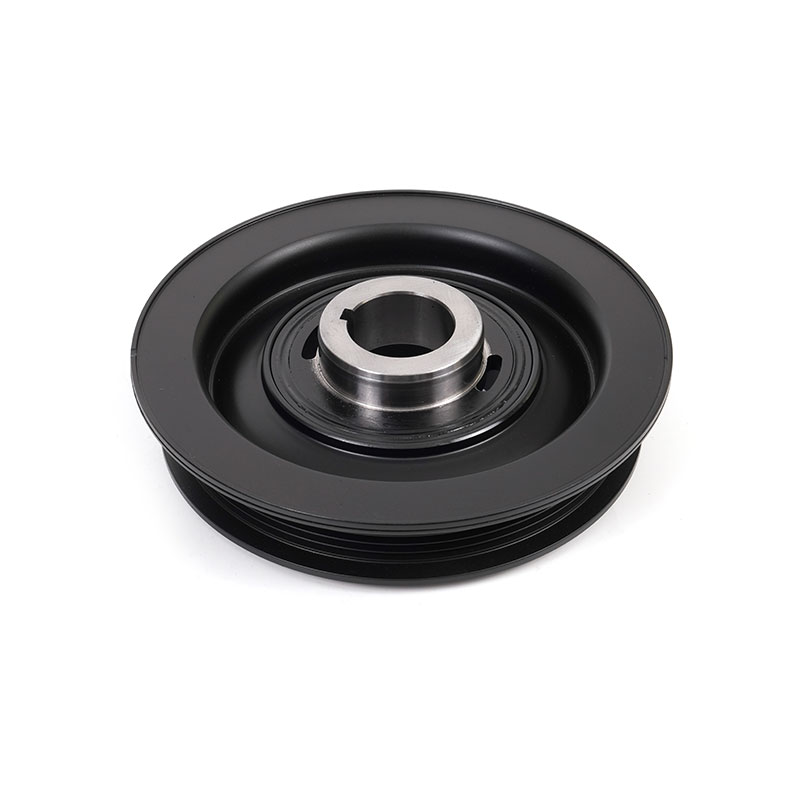
When engineers discuss controlling destructive crankshaft torsional vibration, they reference a fluid damper, viscous damper, or fluid viscous damper interchangeably. Unlike rubber-based harmonic damper pulleys or solid crank pulley harmonic balancers, a fluid viscous damper uses a precisely measured volume of high-viscosity silicone oil housed between a laser-welded outer casing and a free-floating inertia ring. As the engine crankshaft twists from combustion pulses, the inertia ring shears through the silicone fluid. This shear action converts kinetic vibrational energy into harmless low-grade heat, effectively absorbing torsional forces across the entire RPM spectrum, not just a narrow tuned frequency band like traditional elastomer units.
A fluid viscous damper controls destructive torsional vibration through silicone oil shear. The inertia ring moves relative to the housing, shearing highly viscous silicone approximately 45,000 times thicker than motor oil. This converts torsional energy into heat, providing broadband damping from idle to redline without the narrow frequency limitations or heat degradation issues common in rubber elastomer designs.
As a leading 제조업체 그리고 공급업체 of fluid viscous dampers from 중국, we supply global 도매업체 and aftermarket networks. Our engineering team provides full 사용자 지정 가능 그리고 OEM/ODM services, from initial inertia calculations to validation testing. We hold IATF 16949 certification and support bulk orders for heavy-duty truck, marine, and industrial engine applications with documented traceability and fast lead times.
For technical procurement, the fluid viscous damper’s performance hinges on the non-Newtonian properties of the damping medium. A recent 2023 study published in Polish Maritime Research confirmed that silicone-type viscous dampers’ reliability depends on the oil’s ability to absorb energy through non-Newtonian shear flow. Increasing viscosity enhances damping, but only up to an optimal threshold where manufacturing costs outweigh performance gains. The parameter of effectiveness is defined by the fluid flow index, damper gap clearances, and torsional amplitude frequency.
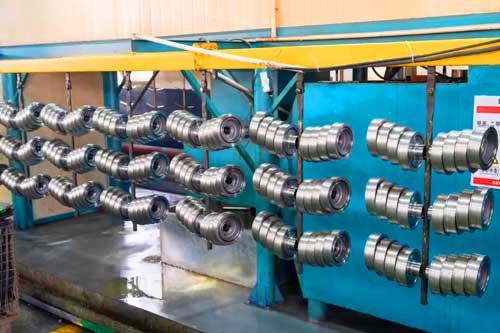
What Is the Core Working Principle of a Fluid Viscous Damper?
A fluid viscous damper consists of three primary components: a precision-machined outer housing, a dense inertia ring, and high-viscosity silicone fluid. The housing mounts directly to the crankshaft nose. When the engine fires, the crankshaft twists and rebounds, creating torsional vibration. The inertia ring, due to its mass, resists this twisting motion and shears through the silicone fluid. This shear action is the fundamental mechanism that eliminates unwanted vibration. The silicone fluid used is a proprietary blend designed to maintain viscosity tolerance across an extreme temperature range of approximately -40°F to 300°F, providing very consistent and predictable damping properties regardless of climate.
In-Depth Technical Analysis: Fluid Dynamics and Thermal Management
This section provides a deep dive into the quantitative engineering parameters behind viscous damper design. The silicone fluid in a new viscous damper is approximately 45,000 times thicker than 30-weight motor oil. Its consistency is closer to a gel than a liquid, which is why fluid viscous dampers are sometimes called solid fluid dampers. This extreme viscosity ensures that the shear stress (τ = μ × du/dy) generates sufficient damping force without requiring mechanical friction.
The energy dissipation follows a power law where the damping force (F) is proportional to the velocity (V) raised to an exponential coefficient (α), typically expressed as F = C × V^α. In standard silicone viscous dampers, the fluid exhibits a shear-thinning effect at high shear rates, which actually enhances damping during peak torsional spikes. Research from Sharif University of Technology (2022) using three-dimensional fluid-structure interaction (FSI) simulations in CFX software demonstrated that while increasing oil film thickness and width decreases the complex damping coefficient, increasing fluid viscosity up to a certain level proportionally increases the torsional damping coefficient and torsional stiffness.
However, there is an optimal viscosity threshold. Beyond this point, the damping performance plateaus while manufacturing costs rise significantly. For custom OEM/ODM projects, the engineering team calculates the required moment of inertia based on the crankshaft’s elastic properties using Holzer’s method. The goal is to shift the system’s natural frequency outside the engine’s operating range. A correctly specified fluid damper reduces peak torsional amplitude by 60-80%, preventing the crankshaft fatigue failure that typically occurs at 0.5+ degrees of angular twist.
Fluid Damper vs. Elastomer (Rubber) Damper
| 특징 | 유체 점성 댐퍼 | 엘라스토머(고무) 댐퍼 | Implication for Buyer |
|---|---|---|---|
| 대역폭 감쇠 | Broadband (Effective all RPM) | Narrow (Tuned to specific Hz) | Viscous better for variable-speed engines (trucks/marine). |
| 온도 범위 | -40°F to 300°F | 제한됨 (열에 의한 고무 경화) | 점성은 극한 기후에 적합함. |
| 실패 모드 | 누출 / 유체 중합 | 고무 균열 / 접합 불량 | 둘 모두 정기 점검이 필요함. |
| 서비스 수명 (헤비 듀티) | 500,000 miles / 15,000 hours | 80,000 – 150,000 마일 | 점성은 총 소유 비용이 낮음. |
커스터마이저블 댐퍼를 위한 OEM 설계 파라미터
중국에서 맞춤형 제조사 또는 OEM/ODM 공급업체와 협업 시, 다음 설계 파라미터를 명시해야 함: 관성 질량 (감쇠 용량 결정), 실리콘 점도 등급 (전단율 및 발열 영향), 하우징 재질 (헤비 듀티용 강철, 경량화용 알루미늄).
FAQ: 유체 댐퍼 기술 사양
점성 댐퍼에 사용되는 실리콘 유체는 무엇인가요?
고점도 및 우수한 열안정성을 가진 합성 실리콘 오일인 폴리디메틸실록산(PDMS)입니다. 화학적으로 비활성이며 무독성이고, 넓은 온도 범위에서 감쇠 성능을 유지합니다.
변형 엔진용 유체 댐퍼는 튜닝이 필요한가요?
특정 주파수에 맞춰 튜닝되는 고무 탄성체 댐퍼와 달리, 유체 점성 댐퍼는 광대역 제어를 제공합니다. 회전 체계의 변화에 적응하므로 재튜닝 없이 변형 또는 고성능 엔진에 이상적입니다.
유체 점성 댐퍼의 유통 기한은 얼마인가요?
건조 환경에 적절히 보관 시 실리콘 유체는 분해되지 않습니다. 그러나 씰이 마를 수 있습니다. 재고는 매년 순환시킬 것을 권장합니다. 설치된 유닛은 500,000마일 또는 15,000시간 교체 주기를 따르세요.
온도가 감쇠 성능에 어떤 영향을 미치나요?
실리콘 유체는 넓은 범위(-40°F ~ 300°F)에서 일정한 점도를 유지합니다. 추위에 경화되는 고무와 달리, 유체 점성 댐퍼는 콜드 스타트 시 즉시 신뢰할 수 있는 감쇠를 제공합니다.
유체 댐퍼는 재생산 또는 재정비가 가능한가요?
예. 일종 대형 정착식 점성 댐퍼는 볼트 체결식 커버를 통해 유체 샘플링, 분석 및 교환이 가능합니다. 용접된 헤비 듀티 트럭용 유닛은 일반적으로 재생산보다 교체됩니다.
유체 댐퍼 제조를 위해 중국 기반 제조업체를 선택하는 이유는 무엇입니까?
중국은 수직 통합(주조, 기계가공, 조립)을 갖춘 고급 IATF 16949 인증 시설을 보유하고 있습니다. 공급업체 및 도매업체로서 우리는 경쟁력 있는 가격, OEM/ODM을 위한 낮은 최소 주문 수량, 빠른 납기(재고 품목 15-30일)를 제공합니다.
출처: 폴란드 해양 연구(2023), 샤리프 공과대학교(2022), SAE J2481 테스트 표준, ISO 1940 밸런스 품질.

 한국어
한국어  English
  简体中文
简体中文  Español
  Français
  Deutsch
  العربية
  Русский
  Português
  Tiếng Việt
  Italiano
  Maithili
  ไทย
ไทย  Türkçe