
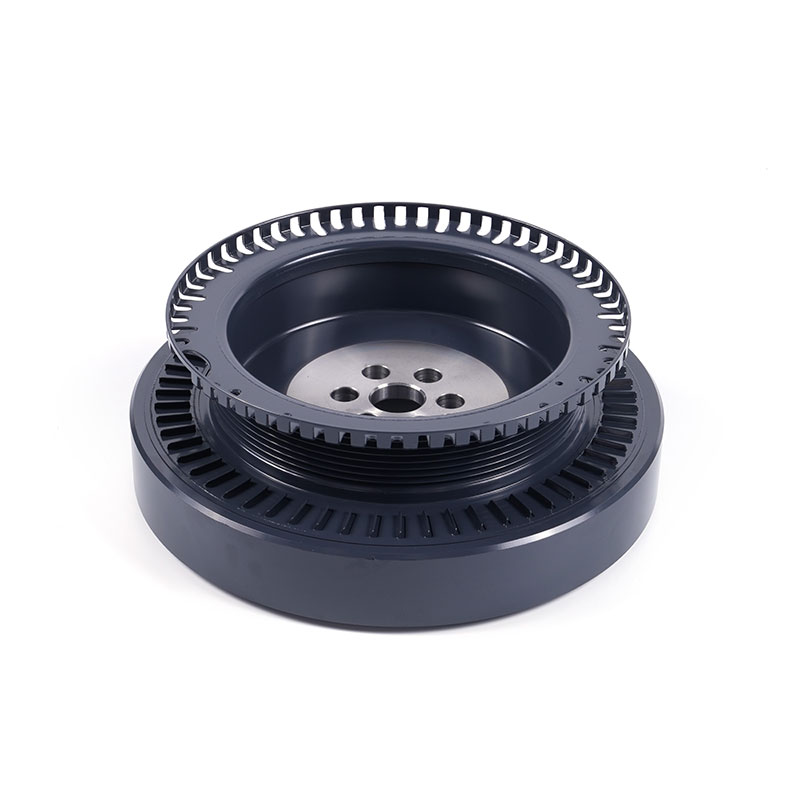
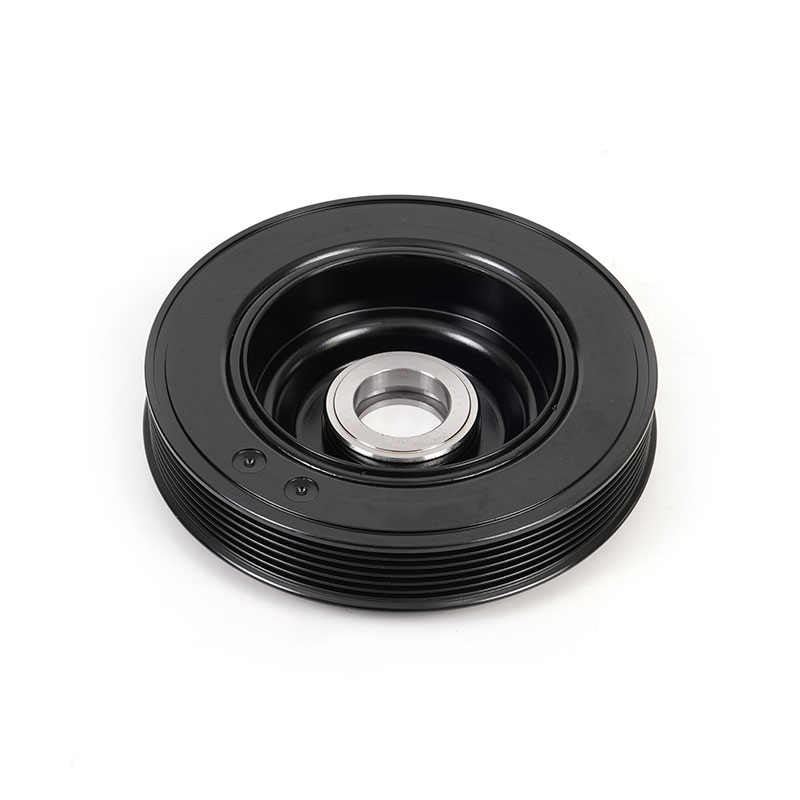
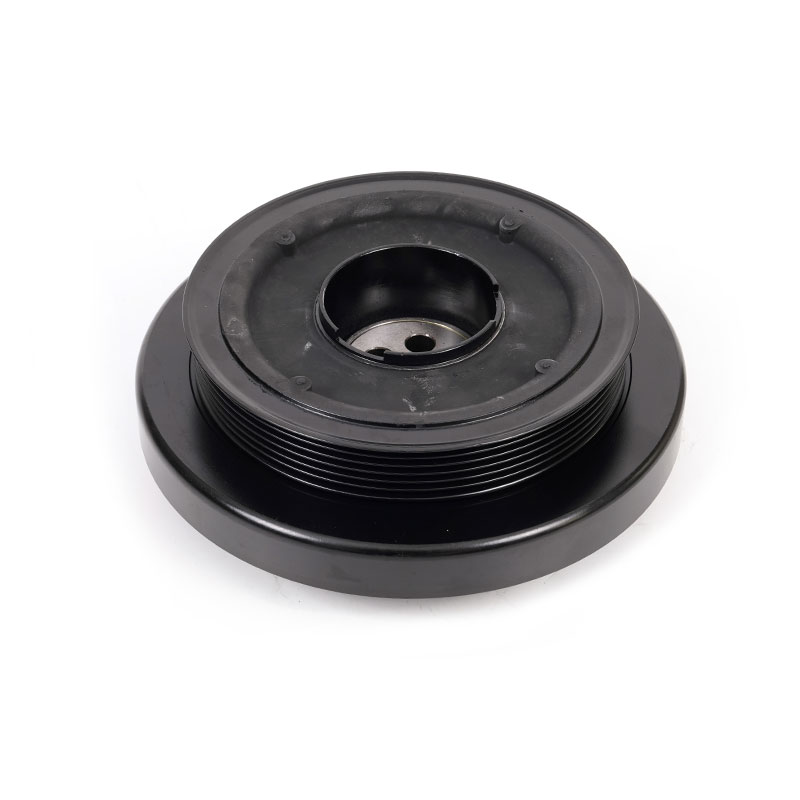
For engineers, the terms fluid damper, viscous damper, 및 fluid viscous damper describe a sophisticated device that uses silicone fluid shear to control destructive torsional vibration. Unlike rubber-based harmonic damper pulley or crank pulley harmonic balancer designs that are tuned to a single frequency, a true engine crankshaft vibration damper with viscous technology provides broadband control from idle to redline. Auramaia engineers 크랭크샤프트 진동 댐퍼 solutions for heavy-duty 엔진 진동 댐퍼 applications requiring maximum durability and thermal stability.
A fluid viscous damper consists of a precision-machined housing, a free-floating inertia ring, and high-viscosity silicone fluid. When the crankshaft twists from cylinder firing, the inertia ring shears through the fluid, converting torsional kinetic energy into heat. This provides broadband damping across all engine orders, unlike rubber dampers that are tuned to a single frequency and degrade with heat exposure.
Auramaia is a 중국-기반으로 제조업체 그리고 공급업체 of 사용자 지정 가능 fluid viscous dampers for 도매업체 그리고 OEM/ODM customers. Our engineering team performs Holzer calculations, finite element analysis, and in-house torsional fatigue testing to validate every design before production.
Why Fluid Beats Rubber: The Physics of Shear Damping
To understand why fluid viscous technology is superior for demanding applications, one must examine the fundamental physics. A rubber elastomer damper is a tuned mass absorber: the rubber ring acts as a spring connecting the hub to the inertia ring. It provides maximum damping at exactly one frequency (typically the engine’s dominant critical order). At all other RPMs, effectiveness drops significantly. As Fluidampr engineers note, “a viscous damper is able to control all frequencies throughout the entire rpm range”[reference:7].
In contrast, a fluid viscous damper contains no mechanical spring. The damping force is generated purely by fluid shear, which is proportional to relative velocity between the housing and inertia ring. This relationship is described by the power-law model for non-Newtonian fluids: τ = K·γⁿ, where τ is shear stress, γ is shear rate, and n is the flow index (<1 for shear-thinning behavior). The silicone fluid’s shear-thinning property provides an elegant self-tuning mechanism: at high shear rates (during peak torsional spikes), viscosity decreases slightly, preventing parasitic drag; during steady-state operation, viscosity normalizes, maintaining consistent damping.
Deep Dive: Thermal Management and Heat Dissipation
One of the most critical engineering parameters for any fluid viscous damper is thermal management. The energy dissipation equation P = μ × (Δω)² × V governs heat generation, where μ is fluid dynamic viscosity, Δω is angular velocity difference between housing and inertia ring, and V is fluid volume in the shear gap. For a typical 12-liter diesel engine producing 1,800 Nm of torque at 1,800 RPM, the damper dissipates approximately 500-800 watts of power as heat during sustained operation.
If this heat cannot be dissipated efficiently, the silicone fluid temperature rises. At temperatures exceeding approximately 150°C, the PDMS polymer chains begin cross-linking—a process called polymerization that gradually increases fluid viscosity. Once viscosity increases beyond the design threshold, the damping coefficient changes, reducing effectiveness. In extreme cases, the fluid can solidify into a paste, locking the inertia ring completely.
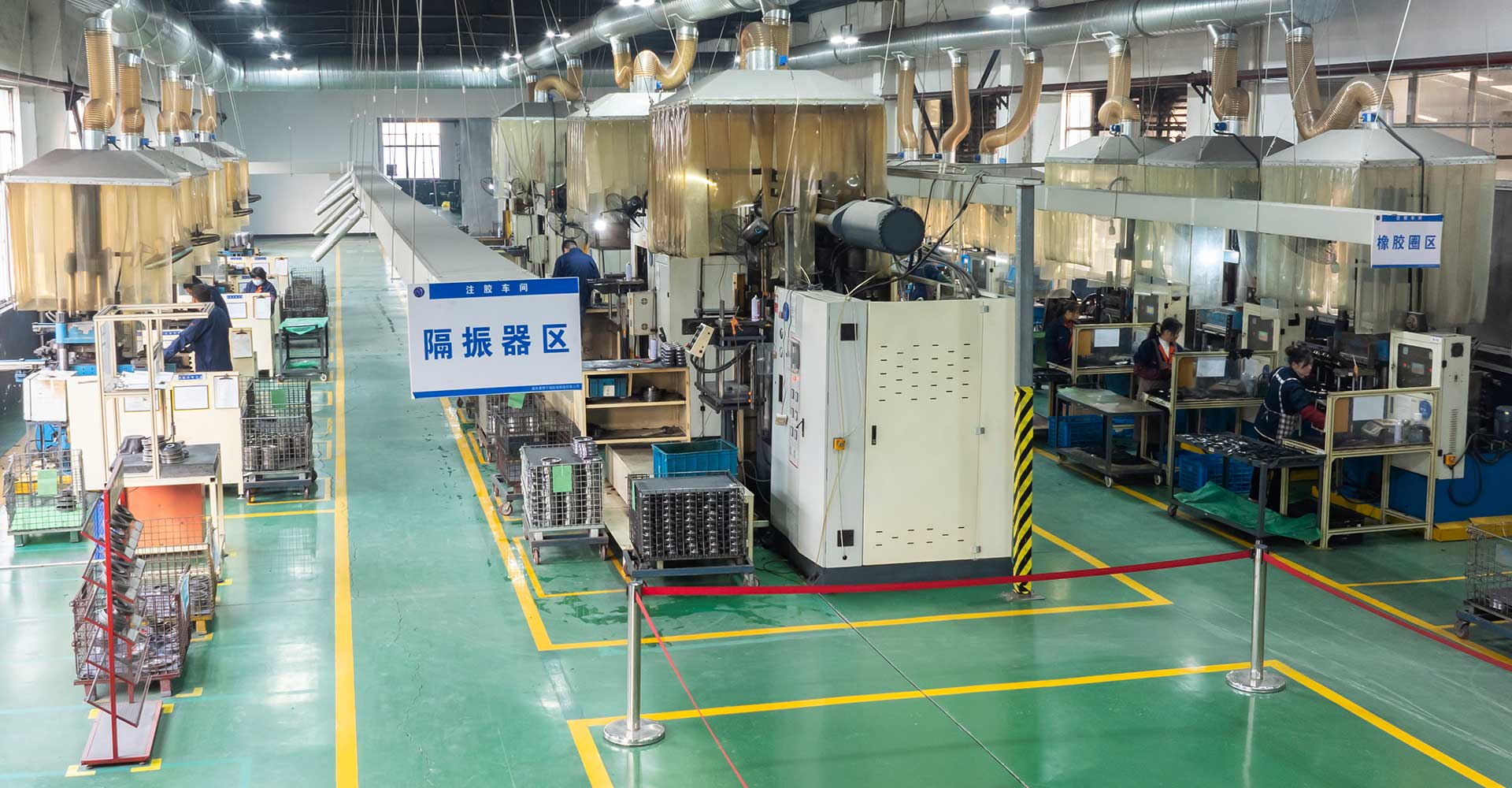
This is why housing design is critical. Premium 제조업체 dampers feature optimized housing geometry with cooling fins or enhanced surface area to radiate heat. The housing-to-fluid surface area ratio directly affects thermal dissipation capacity. Auramaia’s engineering team uses computational fluid dynamics (CFD) simulations to optimize housing design for each application, ensuring that continuous full-load operation does not exceed the fluid’s thermal stability limits.
Industry data shows that rubber elastomer dampers typically fail after 80,000-150,000 miles in heavy-duty applications, primarily due to thermal degradation of the rubber compound[reference:8]. Fluid viscous dampers, with proper thermal management, routinely achieve 500,000 miles or 15,000 hours of service life[reference:9].
실리콘 유체 사양 안내서
B2B 구매자 및 엔지니어에게 올바른 선정을 위해 실리콘 유체 사양을 이해하는 것은 필수적입니다 사용자 지정 가능 댐퍼:
| 매개변수 | 대표값 범위 | 성능에 미치는 영향 |
|---|---|---|
| 25°C에서의 동점도 | 10,000 – 100,000 cSt | 높은 점도는 댐핑 효과를 높이지만 발열도 증가시킵니다 |
| 점도 지수(VI) | 300 – 400 | 높은 VI는 온도 변화에 따른 점도 변화가 적음을 의미합니다 |
| 열안정성 한계 | 150°C – 200°C | 한계를 초과하면 중합이 가속화됩니다 |
| 전단 안정성 | 10⁷ 사이클 후 95%+ 보존율 | 낮은 전단 안정성은 조기 점도 손실을 초래합니다 |
| 작동 온도 범위 | -40°C ~ +150°C | 엔진의 환경 노출 조건과 일치해야 합니다 |
고장 모드 비교: 점검 사항
For maintenance professionals and distributors advising customers, understanding failure indicators is essential:
- Fluid viscous damper failures: External fluid leakage (visible residue around housing weld seam), increased housing temperature during operation (more than 20°C above ambient), gradual increase in engine vibration at specific RPM ranges (indicates fluid polymerization), and inertia ring lock-up (no relative movement between housing and inertia ring when rotated by hand).
- Rubber elastomer damper failures: Visible rubber cracking reaching the bond line, rubber bulging or swelling, rubber hardening (measured by durometer, Shore A increase of 10+ points), hub-to-ring misalignment or wobble, and timing mark shift (indicates hub-to-rubber bond separation).
Testing Standards That Matter
Quality 공급업체 partners validate products against recognized standards. Key references include:
- SAE J2481: Testing of Viscous and Elastomeric Crankshaft Dampers—specifies torsional fatigue test protocols, acceptance criteria, and documentation requirements[reference:10].
- ISO 1940-1: Balance quality requirements for rotating components—G6.3 standard for production units, G2.5 for high-performance applications.
- OEM-specific validation: Many engine manufacturers require additional testing including thermal cycling, burst speed (125% of max RPM), and environmental chamber validation.
Auramaia’s Engineering Capabilities
Auramaia maintains in-house testing equipment including two-plane dynamic balancing machines (ISO 1940 G2.5 capability), torsional fatigue testers (20-million-cycle capacity), environmental chambers (-40°C to +150°C), and burst speed test stands. Our IATF 16949-certified quality system ensures full traceability and documented SPC for critical parameters. For 도매업체 partners, we provide technical documentation including dimensional drawings, balance reports, and material certifications.
FAQ: Technical Specifications and Engineering
What is the difference between a fluid viscous damper and a rubber elastomer damper?
A fluid viscous damper uses high-viscosity silicone fluid to provide broadband damping across all engine RPMs through fluid shear. A rubber elastomer damper uses a bonded rubber ring tuned to a single frequency. Fluid dampers offer superior temperature stability (-40°C to 150°C vs. -20°C to 100°C), longer service life (500,000 miles vs. 80,000-150,000 miles), and no visible wear indicators—making them preferred for heavy-duty applications.
커스텀 애플리케이션용 댐퍼 관성은 어떻게 계산되나요?
댐퍼 관성은 크랭크축을 다중 질량 탄성 시스템으로 모델링하는 홀처 방법으로 계산됩니다. 최적 제어를 위한 목표 관성비(댐퍼 관성 ÷ 크랭크축 시스템 관성)는 일반적으로 0.6에서 1.2 사이입니다. 커스텀 OEM/ODM 프로젝트의 경우, Auramaia 엔지니어링 팀은 귀하의 엔진 사양을 기준으로 이러한 계산을 수행합니다.
유체 점성 댐퍼의 유통 기한은 얼마인가요?
건조하고 기후가 조절된 환경(15-25°C, 습도 60% 미만)에 적절히 보관된 실리콘 유체는 분해되지 않습니다. 그러나 탄성 중합체 씰은 장기 보관 중 건조될 수 있습니다. 업계 관행은 최적의 씰 무결성을 위해 매년 재고를 순환하고 제조일로부터 5년 이내에 설치할 것을 권장합니다.
유체 점성 댐퍼가 거꾸로 설치되면 어떻게 되나요?
유체 점성 댐퍼는 방향 민감성이 있습니다. 거꾸로 설치하면 적절한 댐핑이 제공되지 않으며 즉각적인 불균형을 초래할 수 있습니다. 항상 방향 표시와 토크 사양을 확인하십시오. 자격을 갖춘 공급업체 공급업체는 모든 유닛마다 설치 지침을 제공합니다.
유체 점성 댐퍼는 수리하거나 재조정할 수 있나요?
예, 일종의 대형 프레임 산업용 댐퍼는 유체 샘플링 및 교체를 위한 볼트 온 커버를 갖추고 있습니다. 표준 중형 트럭 댐퍼는 수리보다 교체용으로 설계된 밀봉 유닛입니다. Auramaia는 선별된 산업용 댐퍼 모델에 대해 재조정 서비스를 제공합니다.
극한 저온이 유체 점성 댐퍼 성능에 어떤 영향을 미치나요?
실리콘 유체는 -40°C까지 일관된 점도를 유지하여 콜드 스타트 시 즉각적인 댐핑을 제공합니다. 추운 조건에서 경직되고 부서지기 쉬운 고무 댐퍼와 달리, 유체 댐퍼는 크랭크축 보호를 제공하기 위한 예열 시간이 필요하지 않습니다.
출처: SAE J2481 테스트 표준; Fluidampr 기술 간행물(2016); Auramaia 내부 엔지니어링 데이터.

 한국어
한국어  English
  简体中文
简体中文  Español
  Français
  Deutsch
  العربية
  Русский
  Português
  Tiếng Việt
  Italiano
  Maithili
  ไทย
ไทย  Türkçe