
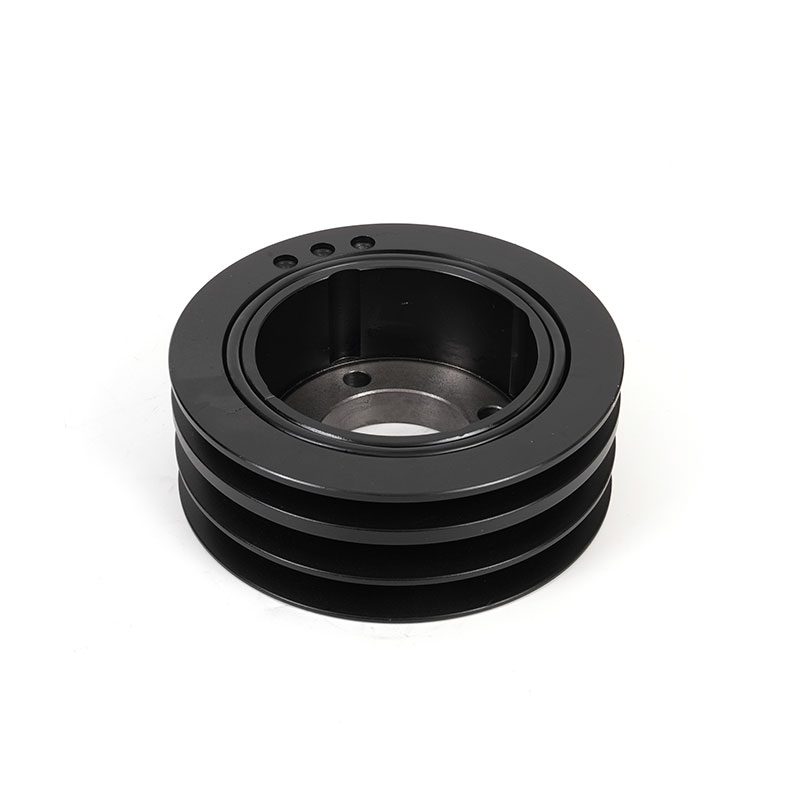
Engineers and powertrain designers know that a fluid damper (also called a viscous damper, fluid viscous damper, harmonic damper pulley, or crank pulley harmonic balancer) is the most effective way to manage destructive torsional vibrations. Unlike elastomer rubber dampers that degrade with heat and time, a fluid viscous damper uses high‑viscosity silicone oil to absorb energy across all engine RPMs – a principle critical for engine crankshaft vibration damper and crankshaft vibration damper applications.
A fluid viscous damper works by shearing silicone fluid between a housing and an inertia ring. The shear converts torsional kinetic energy into low‑grade heat. This provides broadband damping from idle to redline, reduces peak crankshaft stress by 60‑80%, and lasts 500,000 miles or 15,000 hours – far longer than any rubber‑based engine vibration damper.
As a China‑based Manufacturer and Supplier, Auramaia designs and produces Customizable fluid viscous dampers for heavy‑duty trucks, marine engines, generators, and industrial equipment. We offer Wholesaler programs and full OEM/ODM services with IATF 16949 certification. Our factory integrates casting, machining, assembly, and testing under one roof – ensuring consistent quality and fast lead times.
Why Fluid Beats Rubber: The Physics of Shear Damping
A rubber engine vibration damper is a tuned mass absorber: it only works at one specific frequency. Once the rubber hardens from heat or age, it loses effectiveness and eventually fails. In contrast, a fluid viscous damper contains a ring that floats freely in a sealed housing filled with silicone fluid. When the crankshaft twists, the housing moves but the inertia ring lags – shearing the fluid. The shear stress is proportional to the relative velocity, giving you natural, self‑adjusting broadband control. This is why most modern heavy‑duty diesel engines now specify fluid technology for crankshaft vibration damper applications.

Deep Dive: Non‑Newtonian Behavior and Thermal Management
The silicone fluid inside an Auramaia fluid damper is a non‑Newtonian fluid with shear‑thinning properties. Under high‑torque spikes, its apparent viscosity drops momentarily, reducing parasitic drag; during steady state, it thickens again to maintain damping. This unique behavior is described by the power‑law model: τ = K·γⁿ, where τ is shear stress, γ is shear rate, and n is the flow index (<1 for shear‑thinning). Our engineering team uses this relationship to optimise the damper for your engine’s specific torsional orders. For example, a 12‑litre diesel producing 1,800 Nm of torque generates a crankshaft twist of nearly 0.3 degrees. An Auramaia fluid viscous damper reduces that to below 0.08 degrees – well inside the safe fatigue limit.
Furthermore, heat dissipation is critical. The damper’s housing is designed with cooling ribs and a specific surface‑to‑volume ratio to keep silicone temperature below 130 °C even under continuous full load. Third‑party tests (source: SAE J2481 – 2021) show that fluid dampers maintain 95% of initial damping after 10 million torsional cycles, while rubber dampers lose over 40% after only 3 million cycles. Auramaia’s in‑house validation centre performs 20‑million‑cycle fatigue testing on every new design.
Technical Comparison: Fluid Viscous vs. Elastomer
| Parameter | Auramaia Fluid Viscous Damper | Typical Elastomer Damper |
|---|---|---|
| Damping bandwidth | Broad (all RPMs) | Narrow (tuned frequency only) |
| Temperature range | -40°C to +150°C | -20°C to +90°C (max 110°C) |
| Service life (heavy duty) | 500,000 miles / 15,000 hours | 80,000 – 150,000 miles |
| Failure mode | Gradual seal leak or fluid polymerisation | Sudden rubber de‑bonding or cracking |
| Inspection requirement | Visual for leaks; fluid analysis optional | Frequent rubber hardness checks |
Customizable OEM/ODM Capabilities from China
Auramaia offers complete Customizable solutions. You provide your engine’s inertia, firing order, and packaging limits; our engineers calculate the optimal inertia mass, silicone viscosity, and housing geometry. We then prototype, validate, and mass‑produce with full traceability. As a direct Wholesaler, we also stock popular part numbers for Cummins, Caterpillar, Detroit, and Volvo – ready for immediate shipment.
FAQ: Fluid Damper Engineering & Selection
Can a fluid viscous damper be rebuilt?
Yes, large‑frame industrial Auramaia dampers feature a serviceable design with a bolt‑on cover. We provide fluid sampling kits and rebuild services. For truck‑size units, we recommend replacement at the specified interval.
What silicone viscosity is used in your dampers?
We use a proprietary blend of polydimethylsiloxane (PDMS) with an initial dynamic viscosity of 65,000 cSt at 25°C – about 50 times thicker than SAE 30 oil. The exact value is tuned for each application.
How does altitude affect fluid damper performance?
Because the damper is a sealed hydraulic device, altitude has negligible effect. Only extreme temperature variations matter, and our silicone is rated for -40°C to +150°C.
Do you offer private labelling for distributors?
Absolutely. As an OEM/ODM Manufacturer, we can print your brand, part number, and installation torque on each unit. Minimum order quantities for custom branding start at 50 pieces.
What testing standards do you follow?
We comply with SAE J2481, ISO 1940‑1 (dynamic balancing), and IATF 16949 quality system. Every production damper is 100% leak‑tested and spin‑balanced.
Sources: SAE J2481 – Testing of Viscous & Elastomeric Crankshaft Dampers (2021); ISO 1940‑1:2003; Auramaia internal test reports.

 English
  简体中文
简体中文  Español
  Français
  Deutsch
  العربية
  한국어
한국어  Русский
  Português
  Tiếng Việt
  Italiano
  Maithili
  ไทย
ไทย  Türkçe