
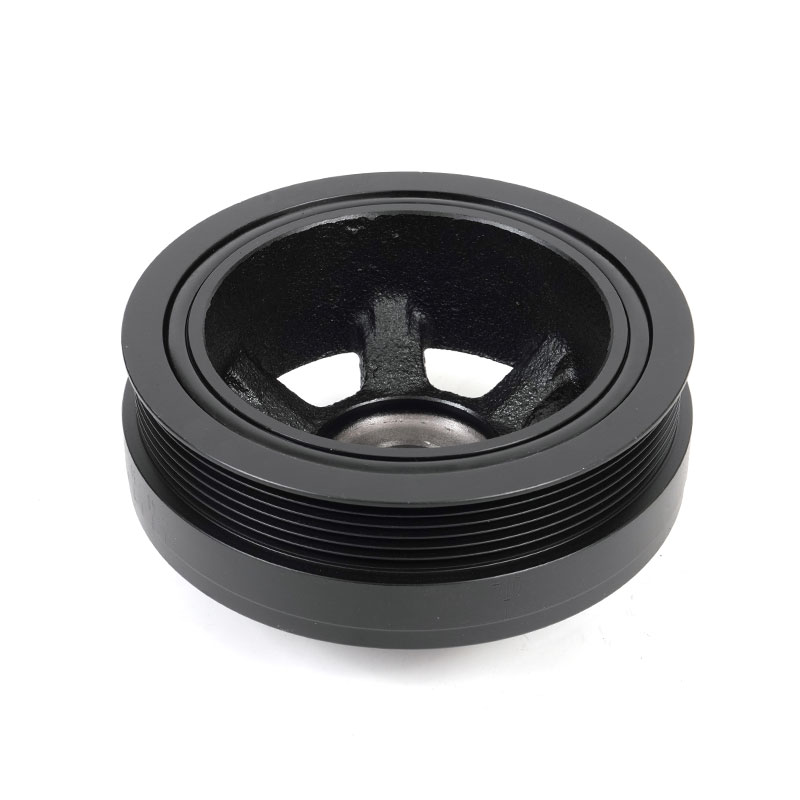
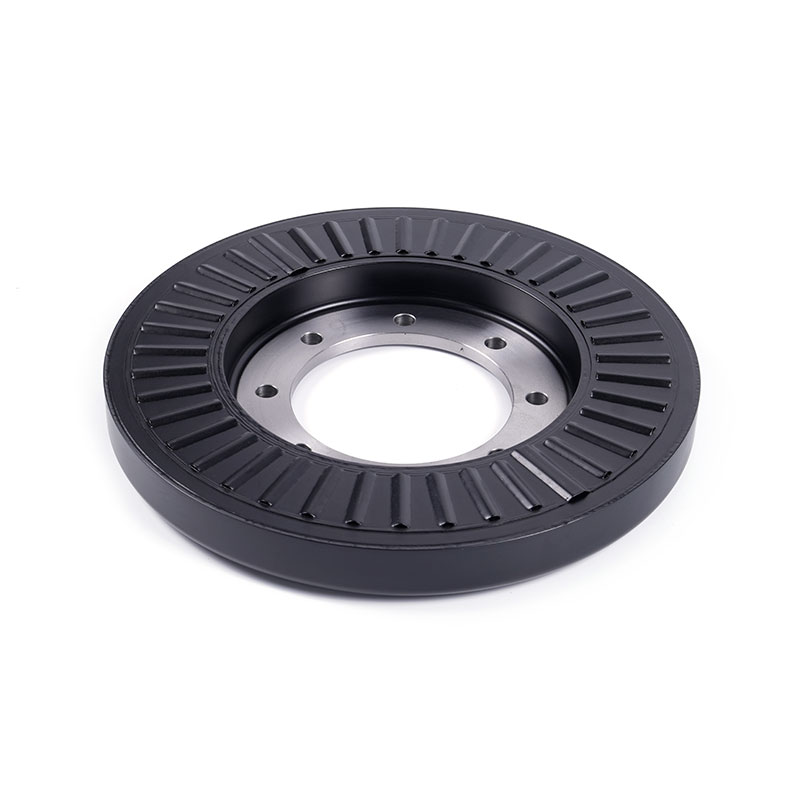
For fleet managers, a fluid damper (often called a viscous damper or fluid viscous damper) mounted on the Cummins, Detroit, or Caterpillar engine is critical for avoiding catastrophic failure. While a standard crank pulley harmonic balancer only transfers power, a heavy-duty fluid viscous damper protects the crankshaft from torsional twisting caused by high cylinder pressures. Ignoring this component leads to bearing wear, gear train noise, and eventually a broken crankshaft costing over $25,000 in downtime and repairs.
Industry data recommends replacing heavy-duty fluid viscous dampers at 500,000 miles or 15,000 operating hours. Failure to replace leads to silicone fluid hardening, causing loss of damping. This increases torsional stress, resulting in broken crankshafts, gear train wear, and unscheduled downtime costing fleets thousands in towing and repairs.
As a reliable Anbieter und Großhändler von flüssigkeitsviskosen Dämpfern aus China, we serve Class 8 fleets and heavy-duty distributors. Our Hersteller direct pricing includes IATF 16949-certified quality, full traceability, and Anpassbar OEM/ODM options for private labeling. We stock high-demand applications for Cummins ISX/X15, Detroit Series 60, and Caterpillar C15 with fast lead times.
For B2B fleet buyers, the financial case for proactive replacement is clear. Standard engine rebuild kits often exclude the damper, yet replacing it during an in-frame overhaul adds minimal labor. Vibratech TVD’s general guideline is 25,000 hours for stationary gensets and 500,000 miles or 15,000 hours for over-the-road Class 8 trucks. In severe duty applications (logging, mining, high-horsepower above 600), dampers may require earlier replacement, with severe duty units offering 37% more mass for increased durability.
Why Does Silicone Wear Out in Heavy Duty Applications?
While silicone is a superior damping medium, in heavy-duty applications it will eventually wear out from normal operating conditions. Over an extended period, the silicone gradually hardens. If the viscous damper is not replaced or refurbished, the silicone could polymerize into a solid paste and lock the internal inertia ring. Regular damper replacement or refurbishing is critical to longer engine life. Signs of wear include loosening or broken bolts, throwing or slapping belts, broken accessory brackets, accessory drive gear wear, loss of torque and horsepower, loss of fuel economy, driver fatigue, and excessive bearing wear.
In-Depth Analysis: Calculating Downtime Costs and ROI
To justify a proactive viscous damper replacement program, fleet managers must quantify the Total Cost of Ownership (TCO). Consider a typical Class 8 truck generating $1.00 per mile in revenue. A catastrophic crankshaft failure results in: Emergency towing ($1,200), Replacement crankshaft and bearings ($5,000-$8,000 parts), Labor (30-40 hours at $150/hr = $4,500-$6,000), Downtime (5-7 days = $5,000-$7,000 lost revenue). Total estimated failure cost: $15,000 – $22,000 per incident. A proactive replacement of a fluid viscous damper costs approximately $500-$1,000 (parts) plus 2 hours of labor ($300). The proactive approach costs $800-$1,300 versus $15,000-$22,000 for reactive failure.
For a fleet of 100 trucks, assuming 1% annual failure rate (one engine), the proactive program saves at least $14,000 annually. However, studies show that fleets without proactive damper replacement see failure rates as high as 5% in severe duty cycles, making the savings exponentially higher. Beyond direct costs, fluid viscous dampers improve fuel economy by stabilizing timing scatter and reducing parasitic drag from belt slap, offering a 0.5-1% fuel economy improvement, translating to thousands in annual fuel savings.
Field Inspection Protocol for Fleet Technicians
- Visual Check: Look for fluid leaks around the housing weld or bulging cover. Any dent or leak warrants immediate replacement.
- Temperature Test: After full load operation, use an IR thermometer. A damper running significantly hotter than ambient suggests internal fluid degradation.
- Noise Assessment: Listen for gear train rattle or knocking at idle.
FAQ: Fleet Maintenance and Viscous Damper Replacement
Wie ist das genaue Austauschintervall für einen Visko-Dämpfer von Cummins ISX?
Für Cummins ISX/X15 wird ein Intervall von 500.000 Meilen oder bei der ersten Grundinstandsetzung empfohlen, je nachdem, was zuerst eintritt. Bei schweren Betriebsbedingungen (600+ PS, Forstwirtschaft/Bergbau) kann ein Austausch nach 350.000 Meilen erforderlich sein.
Kann ich einen Gummidämpfer durch einen hydraulischen Visko-Dämpfer ersetzen?
Ja, sofern die Montagefläche und das Trägheitsmoment übereinstimmen. Hydraulische Dämpfer bieten eine überlegene breitbandige Regelung und eine längere Lebensdauer. Stellen Sie stets beim Lieferanten sicher, dass der Hydraulikdämpfer für Ihr spezifisches Motorenmodell zugelassen ist.
Woher weiß ich, ob mein Visko-Dämpfer defekt ist?
Typische Anzeichen für einen Defekt sind sichtbare Flüssigkeitsrückstände am Gehäuse, Verformung der Abdeckplatte oder übermäßiges Wackeln. Motorsymptome umfassen Klopfen im Frontbereich, Riemenquietschen oder Vibrationen bei bestimmten Drehzahlen.
Erfordert ein Hydraulikdämpfer ein anderes Anzugsmoment als das Originalteil?
Halten Sie stets die Drehmomentvorgaben des Motorenherstellers ein. Verwenden Sie immer neue Befestigungsschrauben, da Dämpferschrauben in den meisten Schwertransportanwendungen streckgrenzengesteuerte Einwegteile sind.
Welchen Vorteil bietet die Beschaffung von Hydraulikdämpfern von einem Werk in China?
In China ansässige Hersteller bieten IATF-16949-Qualität zu wettbewerbsfähigen Preisen. Als Großhändler gewähren wir Mengenrabatte, Private Label (OEM/ODM) und Lagerbestände für schnelle Lieferung, wodurch die Lagerkosten von Fuhrparks reduziert werden.
Beeinflusst der Dämpfer den Kraftstoffverbrauch?
Ja. Ein defekter Dämpfer verursacht Zündzeitpunktstreuungen und Riemenschlupf, wodurch der Kraftstoffverbrauch um 1–2% steigt. Ein einwandfreier hydraulischer Visko-Dämpfer gewährleistet Zündzeitpunktgenauigkeit und reduziert parasitäre Verluste.
Quellen: Vibratech TVD Service Bulletins (2024), TMC Recommended Practice RP 631, Fleet Maintenance Survey Data (2023).

 Deutsch
  English
  简体中文
简体中文  Español
  Français
  العربية
  한국어
한국어  Русский
  Português
  Tiếng Việt
  Italiano
  Maithili
  ไทย
ไทย  Türkçe