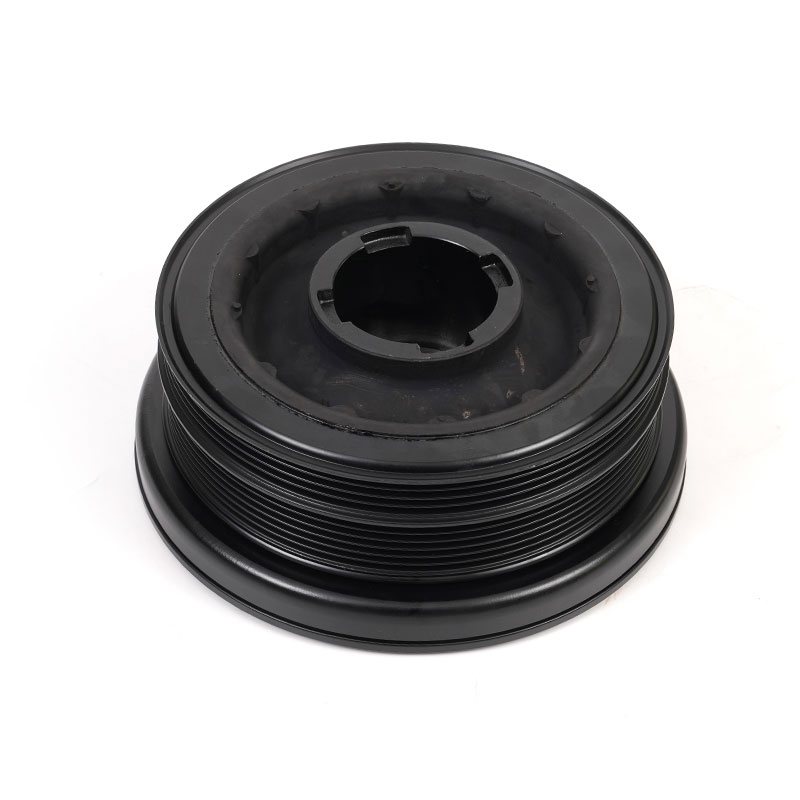
For service technicians and fleet mechanics, a fluid damper (also called a viscous damper 或 曲轴减振器) is one of the most overlooked yet critical components on any diesel engine. Unlike a solid crank pulley harmonic balancer, a fluid viscous damper uses silicone fluid to absorb torsional twist. When it fails, the results are catastrophic: broken crankshafts, destroyed bearings, and an engine that stops without warning. This guide helps you identify, replace, and source the right 发动机减振器 for heavy‑duty trucks, generators, and industrial equipment.
Industry data recommends replacing heavy‑duty fluid viscous dampers at 500,000 miles or 15,000 operating hours. Failure to replace leads to silicone fluid hardening, loss of damping, and crankshaft fatigue failure costing over $25,000 in repairs and downtime. Visible signs of failure include fluid leaks, housing wobble, and increased front‑end vibration.
Auramaia is a China‑based 制造商 和 供应商 of aftermarket fluid dampers for Cummins, Detroit, Caterpillar, PACCAR, and other major engine brands. We offer 批发商 programs, 可定制 private labelling, and full OEM/ODM capabilities, all from our IATF 16949‑certified factory.
When to Replace a Fluid Viscous Damper: The 500,000‑Mile Rule
Leading damper manufacturers such as Vibratech TVD recommend replacement at 500,000 miles or 15,000 hours for over‑the‑road Class 8 trucks. This is not a suggestion—it is an engineering necessity. The silicone fluid inside a viscous damper gradually hardens after prolonged heat exposure. Once hardened, the inertia ring can no longer shear freely, and damping effectiveness drops sharply. Engines rebuilt without replacing the damper suffer greatly reduced life expectancy and face a high risk of crankshaft failure. For stationary engines and generator sets, Vibratech TVD’s guideline is 25,000 operating hours.
Deep Dive: The Silicone Hardening Mechanism
The silicone fluid in a viscous damper is a long‑chain polymer that relies on molecular slippage to convert kinetic energy into heat. After hundreds of millions of shear cycles and thousands of hours at elevated temperatures (typically 90‑120°C), the polymer chains begin to cross‑link—a process called polymerization. The fluid becomes thicker, eventually turning into a gel‑like paste. When this happens, the inertia ring moves in near‑lockstep with the housing, and the damper becomes little more than a heavy, useless lump of metal. The danger is that this process produces no visible external signs. The damper may look perfect but offer zero protection. That is why time‑ or mileage‑based replacement is essential, regardless of appearance. Auramaia uses advanced silicone formulations with enhanced thermal stabilisers to extend service life, but we still recommend following OEM intervals.
Seven Signs Your Fluid Damper Is Failing
- Visible fluid leakage. Any wetness around the housing seam or inertia ring indicates seal failure. Replace immediately.
- Housing wobble. If the damper does not spin true, the inertia ring may be loose or the housing distorted.
- 前端振动加剧。. 减振器失效会导致更多扭转振动,可通过驾驶室或底盘感受到。.
- 皮带噪音或磨损。. 壳体变形导致对中偏移,造成皮带跑偏和皮带轮不均匀磨损。.
- 附件驱动齿轮磨损。. 当减振功能丧失时,正时齿轮和前部附件驱动系统将首当其冲。.
- 燃油经济性下降。. 性能退化的减振器会增大正时分散度,从而降低燃烧效率。.
- 壳体温度过高。. 满负荷运行后,减振器表面温度不应显著高于发动机缸体。.
正确选型的重要性:交叉对照要点解析
使用错误的减振器与使用失效减振器同样有害。错误的惯性值会将临界转速移入工作区间,加剧振动而非抑制振动。专业售后供应商依赖精确的交叉对照数据。例如,康明斯4919864减振器必须与特定发动机系列及马力等级匹配。Auramaia提供涵盖数千种原厂编号的全面交叉对照指南,并通过尺寸验证确保正确适配。.
维修专业人员的安装要点提示
- 务必使用新的安装螺栓。. 大多数现代发动机的减振器螺栓为屈服扭矩螺栓——仅限单次使用。.
- 彻底清洁曲轴前端。. 任何碎屑或腐蚀物都会影响安装定位与平衡。.
- 检测曲轴径向跳动。. 安装新减振器前,需测量曲轴前端径向跳动量。超过0.002英寸(0.05毫米)即需校正。.
- 按规范扭矩拧紧。. Follow the engine manufacturer’s torque sequence and value. Under‑torquing allows loosening; over‑torquing distorts the hub.
- Replace the front crank seal. With the damper removed, replacing the seal adds minimal labour and prevents future leaks.
FAQ: Fluid Damper Replacement and Aftermarket
Can I replace a rubber elastomer damper with a fluid viscous damper?
Yes, provided the mounting interface and inertia value match. Fluid viscous dampers offer broadband control and longer service life, making them a superior choice for heavy‑duty applications. However, always verify with your supplier that the fluid damper is approved for your specific engine model, as the damping characteristics differ from rubber.
How do I cross‑reference an OEM part number to a replacement?
Provide your supplier with the OEM number (e.g., Cummins 4955112, Caterpillar 7C‑7323, Detroit 23514917) and engine serial number. A qualified supplier will cross‑reference to the correct aftermarket part and provide dimensional verification if needed.
What is the warranty on aftermarket fluid dampers?
Auramaia offers a 24‑month warranty on all fluid viscous dampers against manufacturing defects. Extended warranty programs are available for wholesale and fleet accounts.
Do you offer private‑label dampers for my distribution brand?
Yes. As a 制造商 具有 OEM/ODM capabilities, we produce private‑label fluid dampers with your branding, custom packaging, and application‑specific cataloguing. Minimum order quantities apply.
What is the shelf life of a fluid damper before installation?
Properly stored in a dry, climate‑controlled environment (15‑25°C, humidity below 60%), silicone fluid does not degrade. However, elastomer seals may dry out over extended storage. We recommend rotating stock annually and installing within 5 years of manufacture.
Sources: Vibratech TVD – When to Replace a Viscous Crankshaft Damper; Protect Your Engine: It’s a Heavy Duty World Out There! (Vibratech TVD blog, 2025); FinditParts cross‑reference data.


 简体中文
简体中文  English
  Español
  Français
  Deutsch
  العربية
  한국어
한국어  Русский
  Português
  Tiếng Việt
  Italiano
  Maithili
  ไทย
ไทย  Türkçe