
When engineers discuss controlling destructive crankshaft torsional vibration, they reference a fluid damper, viscous damper, or fluid viscous damper interchangeably. Unlike rubber-based harmonic damper pulleys or solid crank pulley harmonic balancers, a fluid viscous damper uses a precisely measured volume of high-viscosity silicone oil housed between a laser-welded outer casing and a free-floating inertia ring. As the engine crankshaft twists from combustion pulses, the inertia ring shears through the silicone fluid. This shear action converts kinetic vibrational energy into harmless low-grade heat, effectively absorbing torsional forces across the entire RPM spectrum, not just a narrow tuned frequency band like traditional elastomer units.
A fluid viscous damper controls destructive torsional vibration through silicone oil shear. The inertia ring moves relative to the housing, shearing highly viscous silicone approximately 45,000 times thicker than motor oil. This converts torsional energy into heat, providing broadband damping from idle to redline without the narrow frequency limitations or heat degradation issues common in rubber elastomer designs.
As a leading 制造商 和 供应商 of fluid viscous dampers from 中国, we supply global 批发商 and aftermarket networks. Our engineering team provides full 可定制 和 OEM/ODM services, from initial inertia calculations to validation testing. We hold IATF 16949 certification and support bulk orders for heavy-duty truck, marine, and industrial engine applications with documented traceability and fast lead times.
For technical procurement, the fluid viscous damper’s performance hinges on the non-Newtonian properties of the damping medium. A recent 2023 study published in Polish Maritime Research confirmed that silicone-type viscous dampers’ reliability depends on the oil’s ability to absorb energy through non-Newtonian shear flow. Increasing viscosity enhances damping, but only up to an optimal threshold where manufacturing costs outweigh performance gains. The parameter of effectiveness is defined by the fluid flow index, damper gap clearances, and torsional amplitude frequency.
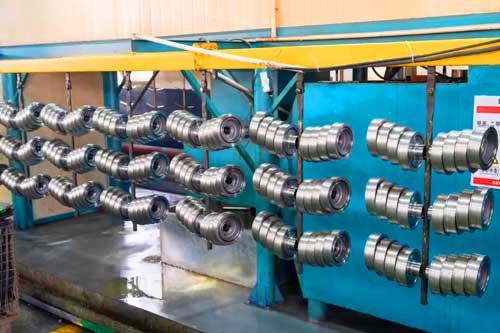
What Is the Core Working Principle of a Fluid Viscous Damper?
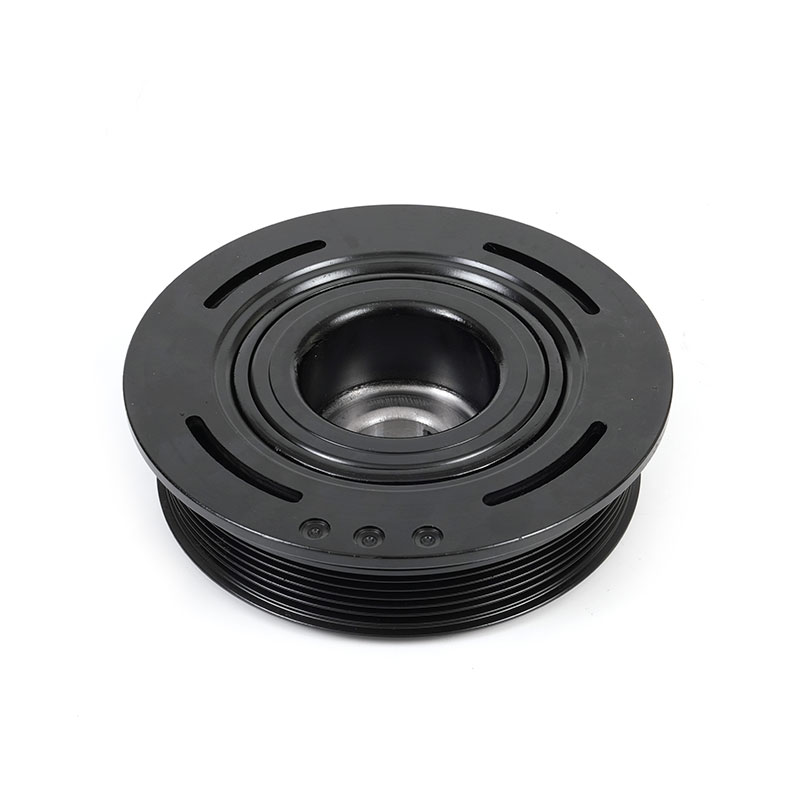
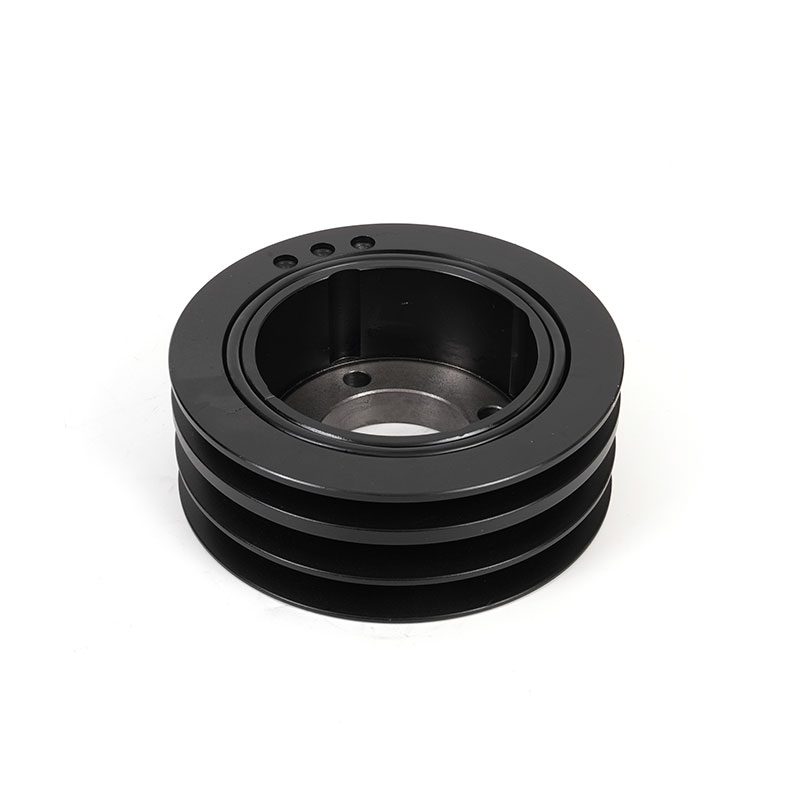
A fluid viscous damper consists of three primary components: a precision-machined outer housing, a dense inertia ring, and high-viscosity silicone fluid. The housing mounts directly to the crankshaft nose. When the engine fires, the crankshaft twists and rebounds, creating torsional vibration. The inertia ring, due to its mass, resists this twisting motion and shears through the silicone fluid. This shear action is the fundamental mechanism that eliminates unwanted vibration. The silicone fluid used is a proprietary blend designed to maintain viscosity tolerance across an extreme temperature range of approximately -40°F to 300°F, providing very consistent and predictable damping properties regardless of climate.
In-Depth Technical Analysis: Fluid Dynamics and Thermal Management
This section provides a deep dive into the quantitative engineering parameters behind viscous damper design. The silicone fluid in a new viscous damper is approximately 45,000 times thicker than 30-weight motor oil. Its consistency is closer to a gel than a liquid, which is why fluid viscous dampers are sometimes called solid fluid dampers. This extreme viscosity ensures that the shear stress (τ = μ × du/dy) generates sufficient damping force without requiring mechanical friction.
The energy dissipation follows a power law where the damping force (F) is proportional to the velocity (V) raised to an exponential coefficient (α), typically expressed as F = C × V^α. In standard silicone viscous dampers, the fluid exhibits a shear-thinning effect at high shear rates, which actually enhances damping during peak torsional spikes. Research from Sharif University of Technology (2022) using three-dimensional fluid-structure interaction (FSI) simulations in CFX software demonstrated that while increasing oil film thickness and width decreases the complex damping coefficient, increasing fluid viscosity up to a certain level proportionally increases the torsional damping coefficient and torsional stiffness.
However, there is an optimal viscosity threshold. Beyond this point, the damping performance plateaus while manufacturing costs rise significantly. For custom OEM/ODM projects, the engineering team calculates the required moment of inertia based on the crankshaft’s elastic properties using Holzer’s method. The goal is to shift the system’s natural frequency outside the engine’s operating range. A correctly specified fluid damper reduces peak torsional amplitude by 60-80%, preventing the crankshaft fatigue failure that typically occurs at 0.5+ degrees of angular twist.
Fluid Damper vs. Elastomer (Rubber) Damper
| 特征 | Fluid Viscous Damper | 弹性体(橡胶)阻尼器 | Implication for Buyer |
|---|---|---|---|
| 阻尼带宽 | Broadband (Effective all RPM) | Narrow (Tuned to specific Hz) | Viscous better for variable-speed engines (trucks/marine). |
| 温度范围 | -40°F to 300°F | 有限使用(受热会硬化橡胶) | 黏性适用于极端气候。. |
| 故障模式 | 泄漏/液体聚合 | 橡胶开裂/脱胶 | 两者都需要定期检查。. |
| 使用寿命(重型) | 50万英里/1.5万小时 | 80,000 – 150,000英里 | 黏性提供更低的总体拥有成本。. |
可定制阻尼器的OEM设计参数
与中国可定制制造商或OEM/ODM供应商合作时,必须指定具体设计参数:惯性质量(决定阻尼能力)、硅油粘度等级(影响剪切速率和发热)、外壳材料(重型用钢,轻量化用铝)。.
FAQ:流体阻尼器技术规格
黏性阻尼器使用什么硅油?
该流体为聚二甲基硅氧烷(PDMS),是一种具有高粘度和优异热稳定性的合成硅油。具有化学惰性、无毒,并在宽温范围内保持阻尼特性。.
流体阻尼器需要针对改装发动机调整吗?
与针对特定频率调整的橡胶弹性体阻尼器不同,流体黏性阻尼器提供宽频控制。它们能适应旋转总成的变化,无需重新调整即可完美适用于改装或高性能发动机。.
流体粘性减振器的保质期是多久?
硅油在干燥环境中妥善储存不会降解,但密封件可能干涸。建议每年周转库存,已安装的单元需遵循50万英里或1.5万小时的更换周期。.
温度如何影响阻尼性能?
硅油在较宽温度范围(-40°F至300°F)内保持粘度稳定。与低温硬化的橡胶不同,流体黏性阻尼器在冷启动时能立即提供可靠阻尼。.
流体阻尼器可以翻新或重建吗?
可以。某些大型固定式黏性阻尼器采用螺栓固定盖板设计,允许进行流体采样、分析和更换。焊接的重型卡车单元通常直接更换而非重建。.
为何选择中国制造商生产流体阻尼器?
中国拥有先进的IATF 16949认证垂直整合生产设施(铸造、机加工、装配)。作为供应商和批发商,我们为OEM/ODM业务提供具有竞争力的价格、较低的最低起订量,以及快速的交货周期(库存件15-30天)。.
参考文献:波兰海事研究(2023年)、谢里夫理工大学(2022年)、SAE J2481测试标准、ISO 1940平衡质量等级。.
 简体中文
简体中文  English
  Español
  Français
  Deutsch
  العربية
  한국어
한국어  Русский
  Português
  Tiếng Việt
  Italiano
  Maithili
  ไทย
ไทย  Türkçe