
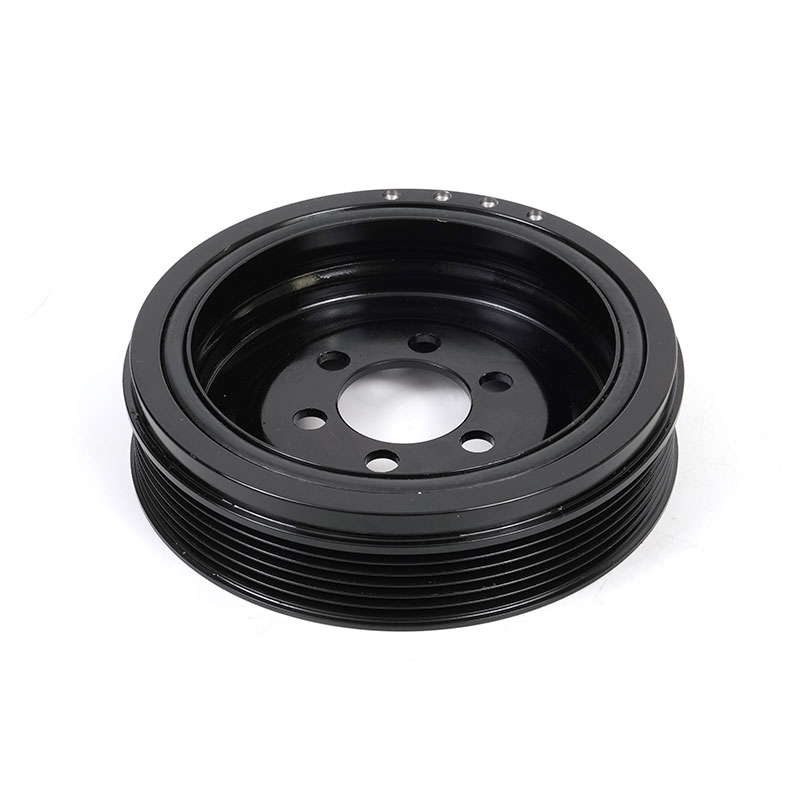
A crankshaft vibration damper is a critical component designed to counteract torsional twisting and resonance in internal combustion engines. By absorbing and dissipating destructive kinetic energy, it protects the crankshaft from fatigue failure, ensures precise valve timing, and extends the service life of engine bearings. Investing in a high-quality damper is essential for maintaining engine integrity and operational efficiency in industrial applications.
Understanding Torsional Stress in Modern Engines
Every time a cylinder fires, the force exerted on the piston creates a torque spike that momentarily twists the crankshaft. This results in torsional vibration. Without an effective engine vibration damper, these oscillations can reach a resonance frequency that leads to catastrophic mechanical failure. As a leading manufacturer, Aura Maia focuses on engineering solutions that neutralize these forces before they cause damage.
Key Functions of an Engine Vibration Damper
- Reduces harmonic resonance to prevent crankshaft snapping
- Protects the timing chain or belt from excessive wear and tear
- Minimizes noise, vibration, and harshness (NVH) for smoother operation
- Maintains the accuracy of fuel injection and valve synchronization
Technical Comparison: Viscous vs. Elastomer Dampers
Choosing the right technology depends on the engine displacement and duty cycle. Below is a comparison of the two primary types of dampers we supply as an OEM/ODM wholesaler.
| Feature | Elastomer (Rubber) Damper | Viscous (Silicone) Damper |
| Mechanism | Inertia ring bonded with rubber | Inertia ring floating in silicone fluid |
| Primary Use | Standard automotive and light commercial | Heavy-duty diesel, marine, and racing |
| Durability | May degrade over time due to heat | Long-lasting with superior heat dissipation |
| Customization | High (Customizable shapes) | High (Customizable viscosity) |
Deep Dive: The Physics of Torsional Vibration Control
The engineering complexity of a torsional damper for crankshaft applications lies in the management of energy transformation. When we design a damper, we calculate the polar moment of inertia to ensure the tuning frequency matches the engine specific harmonic signature. In a viscous damper, the inner inertia mass is not mechanically linked to the housing; instead, it is suspended in a thin film of high-viscosity silicone fluid reaching between 100,000 and 1,000,000 centistokes. As the crankshaft vibrates, the shear strain within the fluid converts the mechanical energy into thermal energy. This process is governed by the damping coefficient, which must remain stable across a temperature range of -40 to 120 degrees Celsius to prevent the fluid from thinning out and losing its protective capabilities.
Partnering with a Reliable Vibration Damper Factory in China
As a specialized vibration damper factory China, we provide customizable solutions for global distributors. Whether you need an industrial vibration damper supplier or a partner for high-volume automotive production, our facility integrates advanced CNC machining with rigorous testing protocols to meet international standards.
 English
  简体中文
简体中文  Español
  Français
  Deutsch
  العربية
  한국어
한국어  Русский
  Português
  Tiếng Việt
  Italiano
  Maithili
  ไทย
ไทย  Türkçe