
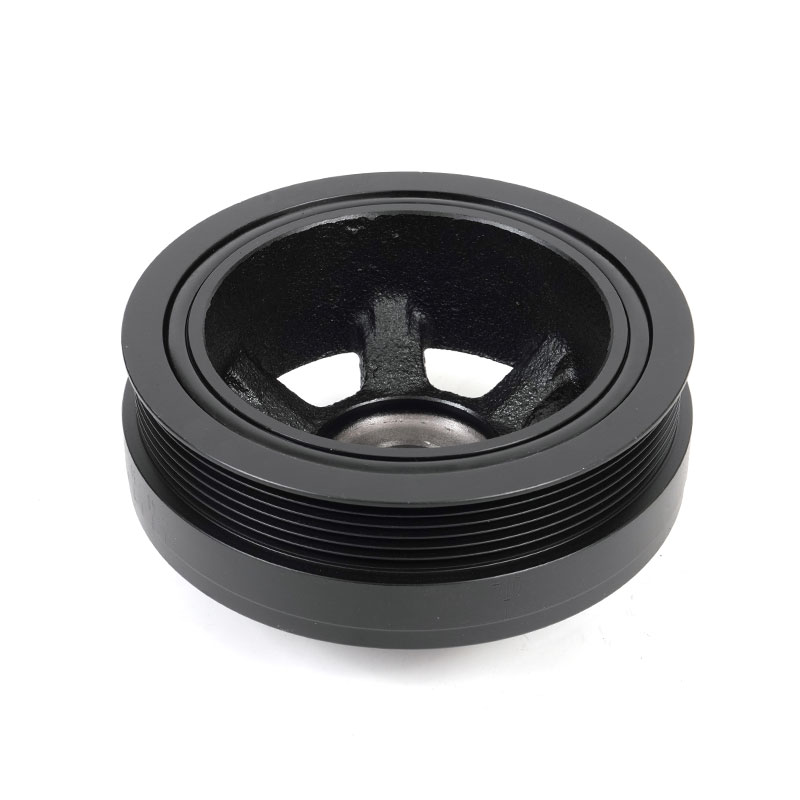
For engineers and technical buyers, the choice between a fluid damper and a rubber elastomer damper is not just about cost—it is about physics. A viscous damper (also called a fluid viscous damper or engine crankshaft vibration damper) uses silicone fluid to provide broadband torsional control across all RPMs. In contrast, a rubber harmonic damper pulley or crank pulley harmonic balancer is tuned to a single frequency and degrades with heat. This technical guide explains the engineering principles behind viscous damping and why it is the superior choice for heavy‑duty, marine, and high‑performance applications.
A fluid viscous damper uses a free‑floating inertia ring submerged in high‑viscosity silicone oil. As the crankshaft twists from cylinder firing, the ring shears through the fluid, converting torsional kinetic energy into low‑grade heat. This provides self‑tuning, broadband damping across all engine orders, unlike rubber dampers that are effective only at one tuned frequency and degrade rapidly under heat.
Auramaia is a China‑based Manufacturer and Supplier of fluid viscous dampers for OEM, aftermarket, and industrial customers. Our Customizable OEM/ODM engineering team uses Holzer calculations and FEA to optimise damping for each engine application, supported by in‑house torsional fatigue testing to 20 million cycles.
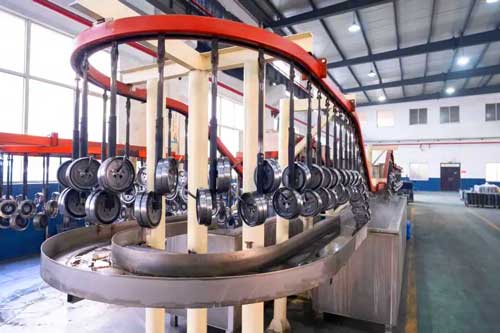
The Physics of Torsional Vibration and Damping
Every internal combustion engine produces torsional vibration—the end‑to‑end twisting and rebounding of the crankshaft caused by the firing sequence. At resonant speeds, the amplitude of this twist can increase by a factor of 10 to 50, rapidly exceeding the crankshaft’s fatigue endurance limit. A crankshaft vibration damper adds mass and damping to the system, shifting natural frequencies and absorbing energy. As Vibratech TVD explains, uncontrolled torsional vibration is harsher under load and as power levels increase, making effective damping essential for engine longevity.
Deep Dive: Fluid Dynamics of Silicone Shear
The silicone oil in a viscous damper exhibits non‑Newtonian shear‑thinning behaviour. Under the high shear rates generated during peak torsional spikes, the fluid’s apparent viscosity drops slightly, reducing parasitic drag and allowing the inertia ring to respond quickly. Under steady‑state operation, the viscosity normalises, maintaining consistent damping. This self‑tuning mechanism is described by the power‑law model: τ = K·γⁿ, where τ is shear stress, γ is shear rate, and n is the flow index (<1 for shear‑thinning). The reliable operation of a silicone‑type viscous damper depends entirely on the ability of the silicone oil to absorb the energy of torsional vibrations through this shear flow. A 2023 study published in Polish Maritime Research confirmed that the non‑Newtonian properties of the oil are the key to effective broadband damping. By contrast, a rubber elastomer damper is a tuned mass absorber: the rubber ring acts as a spring connecting the hub to the inertia ring. It provides maximum damping at exactly one frequency. At all other RPMs, effectiveness drops sharply. Moreover, rubber hardens with heat, permanently changing its stiffness and shifting the tuned frequency away from the target.
Fluid Viscous vs. Elastomer: A Direct Comparison
| Characteristic | Fluid Viscous Damper | Elastomer (Rubber) Damper |
|---|---|---|
| Damping bandwidth | Broad (effective all RPMs) | Narrow (tuned to one frequency) |
| Temperature range | -40°C to +150°C | -20°C to +100°C (max 110°C with synthetic) |
| Service life (heavy‑duty) | 500,000 miles / 15,000 hours | 80,000‑150,000 miles |
| Failure mode | Gradual fluid polymerisation (invisible) | Visible rubber cracking, de‑bonding, hardening |
| Effect on modified engines | Self‑tuning; adapts to changes | Requires re‑tuning; mismatched if engine modified |
Why Broadband Damping Matters in Real‑World Operation
A rubber damper works well at the specific engine order for which it was tuned—for example, the 4th order of a four‑cylinder diesel at cruising RPM. But when the engine accelerates, decelerates, or idles, the damper is operating outside its optimal range. This is why many fleets experience front‑end gear noise at idle even with a new rubber damper. A fluid viscous damper, in contrast, controls all frequencies simultaneously. As Fluidampr’s Ivan Snyder explains, “A viscous damper is able to control all frequencies throughout the entire RPM range.” This means quieter idling, smoother acceleration, and consistent protection regardless of load or speed.
The Thermal Advantage of Fluid Damping
Heat is the enemy of rubber. Under sustained full load—such as a truck climbing a mountain pass or a generator running at prime power—the rubber element in an elastomer damper can exceed 100°C, accelerating hardening and cracking. Silicone fluid, however, remains stable up to 150°C. The fluid also conducts heat away from the inertia ring and into the housing, where it is dissipated by air flow. This thermal stability is why marine and generator applications almost exclusively specify fluid viscous dampers.
FAQ: Technical Engineering
Can a fluid viscous damper be repaired or rebuilt?
Yes, some large‑frame industrial dampers feature a bolt‑on cover for fluid sampling and replacement. Standard heavy‑duty truck dampers are sealed units designed for replacement rather than repair. Auramaia offers rebuild services for select industrial models.
How does cold starting affect fluid viscous dampers?
Silicone fluid maintains consistent viscosity down to -40°C, providing immediate damping upon cold start. Unlike rubber dampers, which become stiff and brittle in freezing conditions, fluid dampers require no warm‑up period to protect the crankshaft.
What is the shelf life of a fluid damper before installation?
Properly stored in a dry, climate‑controlled environment, silicone fluid does not degrade. However, elastomer seals may dry out over extended storage. We recommend rotating stock annually and installing within 5 years of manufacture.
How do you calculate the correct inertia for a custom engine?
Our engineers use the Holzer method, which models the crankshaft as a multi‑mass elastic system. The target inertia ratio (damper inertia ÷ crankshaft system inertia) typically falls between 0.6 and 1.2 for optimal control. We then validate the design with FEA and torsional fatigue testing.
What testing standards do you follow?
We comply with SAE J2481 for torsional fatigue testing (10‑20 million cycles), ISO 1940‑1 for dynamic balancing (G6.3 or G2.5), and IATF 16949 for quality management. Every production damper is 100% leak‑tested and spin‑balanced.
Sources: Polish Maritime Research (2023); Fluidampr PRI Show 2016; Vibratech TVD technical publications; SAE J2481 test standards.

 English
  简体中文
简体中文  Español
  Français
  Deutsch
  العربية
  한국어
한국어  Русский
  Português
  Tiếng Việt
  Italiano
  Maithili
  ไทย
ไทย  Türkçe