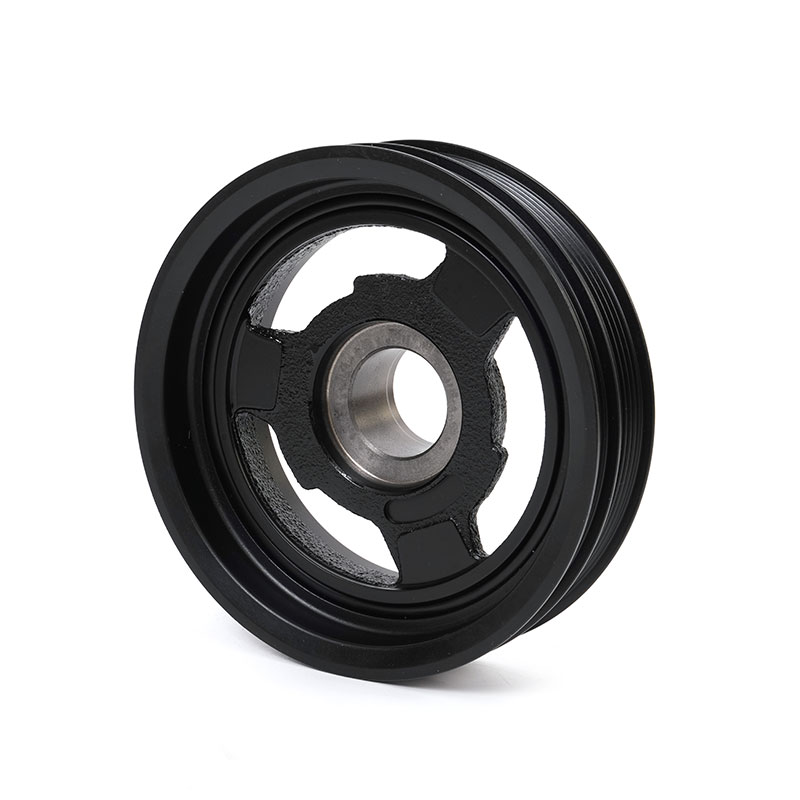
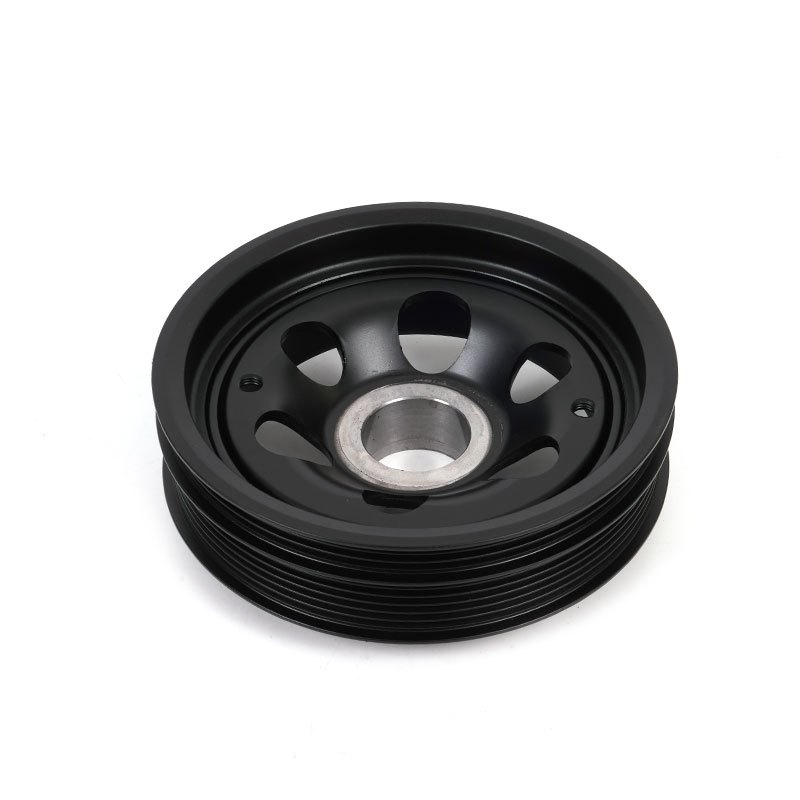
For engine designers and OEM engineering teams, a fluid damper is not an off‑the‑shelf accessory—it is a precisely tuned dynamic component that must be matched to the unique torsional characteristics of each engine platform. Whether you call it a viscous damper, a fluid viscous damper, a harmonic damper pulley, or a crankshaft vibration damper, the engineering process is the same: analyse, simulate, prototype, validate, and produce. This guide walks through the steps of custom engine vibration damper development, from initial parameter analysis to production release.
Custom fluid damper development begins with Holzer analysis of the crankshaft system to determine critical natural frequencies and mode shapes. The damper’s inertia and damping coefficient are then optimised to reduce peak torsional amplitude by 60‑80%. Prototypes undergo 10‑20 million cycle torsional fatigue testing and thermal cycling from -40°C to +150°C before production release.
Auramaia is a China‑based Manufacturer and Supplier offering full Customizable OEM/ODM engineering services for fluid dampers. Our vertically integrated factory and in‑house validation centre (IATF 16949 certified) provide complete design‑to‑delivery capability for global engine OEMs.
Step 1: Torsional Vibration Analysis
The starting point for any custom damper project is a thorough analysis of the target engine’s torsional characteristics. Key inputs include: cylinder configuration and firing order, bore and stroke, rated power and torque, maximum RPM, crankshaft geometry (main journal diameters, throw dimensions, number of main bearings), and flywheel inertia. Using the Holzer method, engineers model the crankshaft as a series of lumped masses connected by torsional springs. This calculation identifies the system’s natural frequencies and mode shapes—the exact RPMs where resonance occurs and where the damper must be most effective.
Deep Dive: Advanced Simulation and Validation
Modern damper development goes beyond Holzer analysis. Leading OEMs and suppliers such as Vibratech TVD use CAD simulation modelling, finite element analysis (FEA), and 3D‑printed prototypes to accelerate development. FEA validates the damper’s structural integrity under centrifugal loads at maximum RPM, while Multi‑Body Dynamics (MBD) simulation models the complete engine assembly, including cylinder pressure curves and bearing clearances, to predict torsional amplitudes at every node along the crankshaft. A 2021 SAE study demonstrated that MBD‑optimised dampers reduced peak torsional stress by 45% compared to traditionally tuned components. Auramaia’s engineering team uses these same advanced tools, combined with over 20 years of proprietary data, to optimise damper designs for each unique engine application. We also perform physical validation on engine dynamometers with high‑resolution encoders and spectrum analysers, confirming that simulation models accurately predict real‑world behaviour.
Step 2: Damper Parameter Optimisation
With the crankshaft’s natural frequencies identified, the engineering team calculates the required damper characteristics:
- Inertia ratio: Typically 0.6 to 1.2 times the crankshaft inertia. Higher ratios provide more control but increase weight and cost.
- Fluid viscosity: Ranges from 10,000 to 100,000 centistokes at 25°C. Higher viscosity provides more damping but generates more heat.
- Shear gap: The clearance between housing and inertia ring (typically 0.5‑2.0 mm) directly affects fluid shear rate and heat dissipation.
- Housing material: Steel for heavy‑duty applications, aluminium for weight‑sensitive designs.
Step 3: Prototyping and Validation Testing
Before mass production, every custom damper design undergoes rigorous validation. Auramaia’s in‑house test centre performs:
- Torsional fatigue testing: 10‑20 million cycles at the damper’s tuned frequency, monitoring temperature rise and stiffness shift.
- Dynamic balancing: ISO 1940‑1 G6.3 or better for production units, G2.5 for high‑performance applications.
- Environmental chamber validation: -40°C to +150°C to confirm performance across extreme operating conditions.
- Burst speed testing: 125% of maximum rated RPM to validate structural integrity.
- Leak testing: Helium leak detection to 1×10⁻⁶ mbar·L/s—100 times more sensitive than bubble testing.
Why Choose Auramaia for Custom OEM/ODM Projects
Auramaia offers a complete custom damper service: from initial Holzer analysis and FEA simulation to prototype production, validation testing, and mass production. Our IATF 16949‑certified factory produces over 50,000 dampers annually, with full traceability from raw material to finished component. We serve engine OEMs, aftermarket distributors, and industrial equipment manufacturers worldwide, offering Customizable designs, private labelling, and competitive lead times from our China facility.
Case Study: Custom Damper for a High‑Output Diesel
An engine manufacturer developing a 600+ horsepower off‑highway diesel approached Auramaia for a custom fluid damper. The engine had experienced front‑end gear noise and bearing wear with an off‑the‑shelf damper. Our analysis revealed that the existing damper’s inertia was 15% too low for the modified rotating assembly. We designed a new damper with increased inertia mass, a steel housing, and a higher‑viscosity silicone fluid. After 20 million cycles of torsional fatigue testing and field validation, the new damper eliminated gear noise, reduced bearing wear by 60%, and extended the engine’s overhaul interval by 30%.
FAQ: OEM/ODM Engineering
What technical data do I need to provide for a custom damper design?
We require engine specifications: cylinder configuration, firing order, bore and stroke, rated power and torque, maximum RPM, crankshaft geometry (main journal diameters, throw dimensions, number of main bearings), flywheel inertia, and any packaging constraints (maximum OD, available depth, mounting interface details).
What is the typical lead time for a custom fluid damper project?
From design freeze to first prototype: 45‑60 days. Production orders after prototype approval: 30‑45 days for the first 500 units. We can accelerate timelines for urgent projects.
Do you offer exclusive designs for OEM customers?
Yes. As an OEM/ODM Manufacturer, we produce exclusive damper designs that are not offered to other customers. Tooling and development costs are amortised across production volumes.
What documentation do you provide with custom damper shipments?
Each shipment includes a certificate of conformance (COC), dynamic balance reports, material certifications, and full traceability records. For marine or defence applications, we can provide classification society documentation (DNV, Lloyd’s Register, ABS).
Can you integrate remote monitoring sensors into custom dampers?
Yes. For large‑frame industrial and generator dampers, we can integrate temperature sensors and wireless transmitters for real‑time performance monitoring. This enables predictive maintenance and reduces unplanned downtime.
Sources: SAE J2481 testing standards; Vibratech TVD custom solution case studies; SAE Paper 2021‑01‑0872 (MBD damper optimisation); Auramaia engineering data.
 English
  简体中文
简体中文  Español
  Français
  Deutsch
  العربية
  한국어
한국어  Русский
  Português
  Tiếng Việt
  Italiano
  Maithili
  ไทย
ไทย  Türkçe