
When engineers discuss controlling destructive crankshaft torsional vibration, they reference a fluid damper, viscous damper, or fluid viscous damper interchangeably. Unlike rubber-based harmonic damper pulleys or solid crank pulley harmonic balancers, a fluid viscous damper uses a precisely measured volume of high-viscosity silicone oil housed between a laser-welded outer casing and a free-floating inertia ring. As the engine crankshaft twists from combustion pulses, the inertia ring shears through the silicone fluid. This shear action converts kinetic vibrational energy into harmless low-grade heat, effectively absorbing torsional forces across the entire RPM spectrum, not just a narrow tuned frequency band like traditional elastomer units.
A fluid viscous damper controls destructive torsional vibration through silicone oil shear. The inertia ring moves relative to the housing, shearing highly viscous silicone approximately 45,000 times thicker than motor oil. This converts torsional energy into heat, providing broadband damping from idle to redline without the narrow frequency limitations or heat degradation issues common in rubber elastomer designs.
As a leading Manufacturer and Supplier of fluid viscous dampers from China, we supply global Wholesaler and aftermarket networks. Our engineering team provides full Customizable and OEM/ODM services, from initial inertia calculations to validation testing. We hold IATF 16949 certification and support bulk orders for heavy-duty truck, marine, and industrial engine applications with documented traceability and fast lead times.
For technical procurement, the fluid viscous damper’s performance hinges on the non-Newtonian properties of the damping medium. A recent 2023 study published in Polish Maritime Research confirmed that silicone-type viscous dampers’ reliability depends on the oil’s ability to absorb energy through non-Newtonian shear flow. Increasing viscosity enhances damping, but only up to an optimal threshold where manufacturing costs outweigh performance gains. The parameter of effectiveness is defined by the fluid flow index, damper gap clearances, and torsional amplitude frequency.
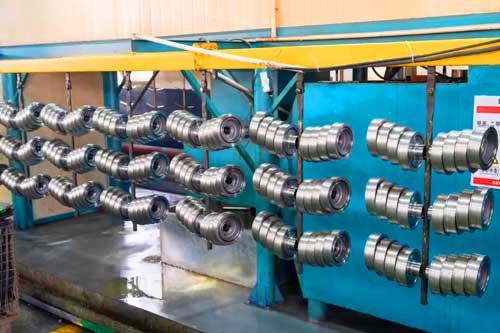
What Is the Core Working Principle of a Fluid Viscous Damper?
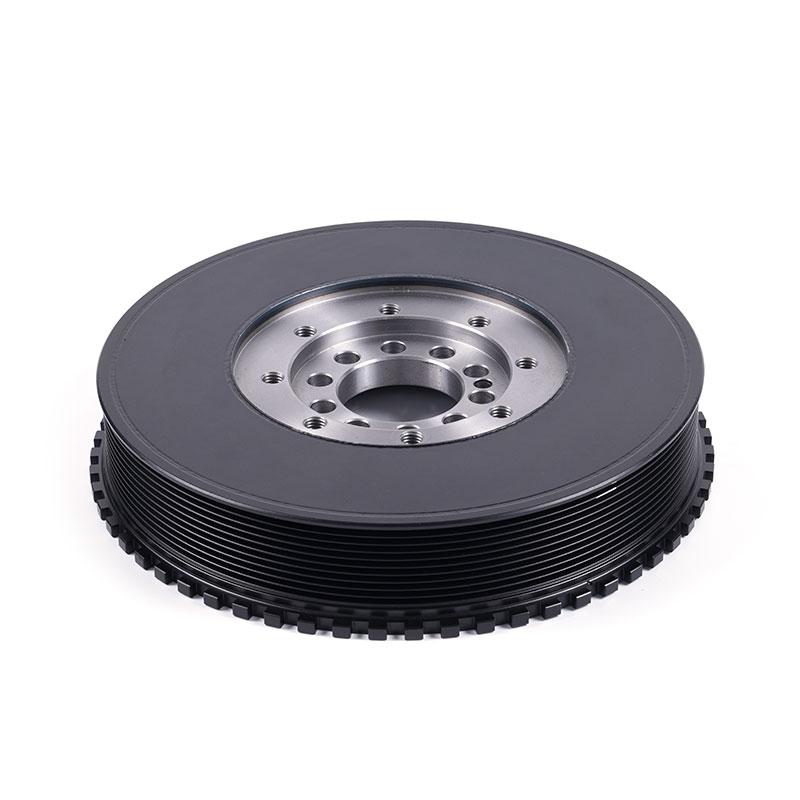
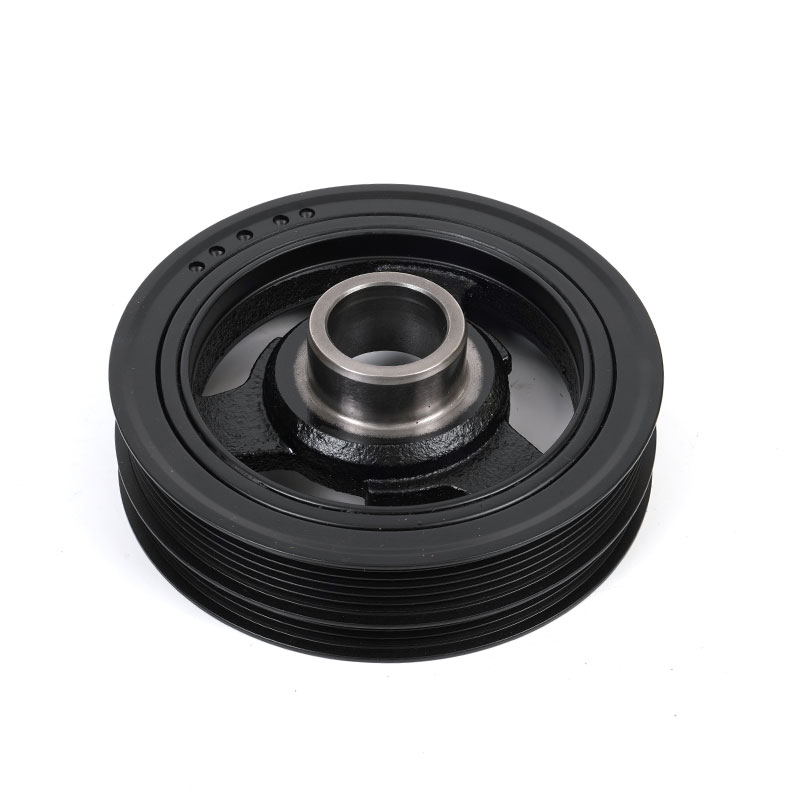
A fluid viscous damper consists of three primary components: a precision-machined outer housing, a dense inertia ring, and high-viscosity silicone fluid. The housing mounts directly to the crankshaft nose. When the engine fires, the crankshaft twists and rebounds, creating torsional vibration. The inertia ring, due to its mass, resists this twisting motion and shears through the silicone fluid. This shear action is the fundamental mechanism that eliminates unwanted vibration. The silicone fluid used is a proprietary blend designed to maintain viscosity tolerance across an extreme temperature range of approximately -40°F to 300°F, providing very consistent and predictable damping properties regardless of climate.
In-Depth Technical Analysis: Fluid Dynamics and Thermal Management
This section provides a deep dive into the quantitative engineering parameters behind viscous damper design. The silicone fluid in a new viscous damper is approximately 45,000 times thicker than 30-weight motor oil. Its consistency is closer to a gel than a liquid, which is why fluid viscous dampers are sometimes called solid fluid dampers. This extreme viscosity ensures that the shear stress (τ = μ × du/dy) generates sufficient damping force without requiring mechanical friction.
The energy dissipation follows a power law where the damping force (F) is proportional to the velocity (V) raised to an exponential coefficient (α), typically expressed as F = C × V^α. In standard silicone viscous dampers, the fluid exhibits a shear-thinning effect at high shear rates, which actually enhances damping during peak torsional spikes. Research from Sharif University of Technology (2022) using three-dimensional fluid-structure interaction (FSI) simulations in CFX software demonstrated that while increasing oil film thickness and width decreases the complex damping coefficient, increasing fluid viscosity up to a certain level proportionally increases the torsional damping coefficient and torsional stiffness.
However, there is an optimal viscosity threshold. Beyond this point, the damping performance plateaus while manufacturing costs rise significantly. For custom OEM/ODM projects, the engineering team calculates the required moment of inertia based on the crankshaft’s elastic properties using Holzer’s method. The goal is to shift the system’s natural frequency outside the engine’s operating range. A correctly specified fluid damper reduces peak torsional amplitude by 60-80%, preventing the crankshaft fatigue failure that typically occurs at 0.5+ degrees of angular twist.
Fluid Damper vs. Elastomer (Rubber) Damper
| Characteristic | Fluid Viscous Damper | Elastomer (Rubber) Damper | Implication for Buyer |
|---|---|---|---|
| Damping Bandwidth | Broadband (Effective all RPM) | Narrow (Tuned to specific Hz) | Viscous better for variable-speed engines (trucks/marine). |
| Temperature Range | -40°F to 300°F | Limited (Heat hardens rubber) | Viscous suitable for extreme climates. |
| Failure Mode | Leakage / Fluid polymerize | Rubber cracking / de-bonding | Both require periodic inspection. |
| Service Life (Heavy Duty) | 500,000 miles / 15,000 hours | 80,000 – 150,000 miles | Viscous offers lower total cost of ownership. |
OEM Design Parameters for Customizable Dampers
When working with a Customizable Manufacturer or OEM/ODM supplier in China, specific design parameters must be specified: Inertia Mass (determines damping capacity), Silicone Viscosity Grade (affects shear rate and heat generation), and Housing Material (steel for heavy-duty, aluminum for weight savings).
FAQ: Technical Specifications for Fluid Dampers
What is the silicone fluid used in viscous dampers?
The fluid is polydimethylsiloxane (PDMS), a synthetic silicone oil with high viscosity and excellent thermal stability. It is chemically inert, non-toxic, and maintains its damping properties over a wide temperature range.
Does a fluid damper require tuning for modified engines?
Unlike rubber elastomer dampers which are tuned to a specific frequency, fluid viscous dampers provide broadband control. They adapt to changes in the rotating assembly, making them ideal for modified or high-performance engines without requiring re-tuning.
What is the shelf life of a fluid viscous damper?
Properly stored in a dry environment, silicone fluid does not degrade. However, seals may dry out. It is recommended to rotate stock annually. For installed units, follow the 500,000-mile or 15,000-hour replacement interval.
How does temperature affect damping performance?
Silicone fluid maintains consistent viscosity across a wide range (-40°F to 300°F). Unlike rubber which hardens in the cold, a fluid viscous damper provides reliable damping immediately upon cold start.
Can a fluid damper be rebuilt or refurbished?
Yes. Some large-scale stationary viscous dampers feature bolt-on covers allowing fluid sampling, analysis, and replacement. Welded heavy-duty truck units are typically replaced rather than rebuilt.
Why choose a China-based Manufacturer for fluid dampers?
China offers advanced IATF 16949-certified facilities with vertical integration (casting, machining, assembly). As a Supplier and Wholesaler, we provide competitive pricing, low MOQs for OEM/ODM, and fast lead times (15-30 days for stock items).
Sources: Polish Maritime Research (2023), Sharif University of Technology (2022), SAE J2481 Testing Standards, ISO 1940 Balance Quality.
 English
  简体中文
简体中文  Español
  Français
  Deutsch
  العربية
  한국어
한국어  Русский
  Português
  Tiếng Việt
  Italiano
  Maithili
  ไทย
ไทย  Türkçe