
TECHNICAL CENTER 21 Aug · 6:47 am
The crankshaft pulley transmits the rotary movement of the crankshaft to the engine drive and drives components such as the alternator, air conditioning compressor or servo pump. While simple pulleys are made of solid material, modern designs are designed as vibration dampers to absorb torsional vibrations from the engine. An exact assignment to the engine code is crucial, as incorrect designs can lead to considerable damage to the belt drive or even to the crankshaft.
Structure and function of the crankshaft pulley
The crankshaft pulley is rigidly attached to the front end of the crankshaft and acts as the driving wheel for the V-ribbed belt. In modern combustion engines with high loads and start-stop systems, the component is designed as a vibration damper to compensate for rotational irregularities.
The design of modern damped pulleys includes a metallic inner core that is firmly bolted to the crankshaft and an outer belt race. In between is an elastic layer made of high-quality elastomer or special spring elements that decouple the vibrations and calm the engine running.
When assembling these torque-critical components, it is imperative to maintain the torque prescribed by the vehicle manufacturer. These are often expansion bolts that have to be replaced with new components each time they are dismantled to ensure a permanent connection and the preservation of the preload.
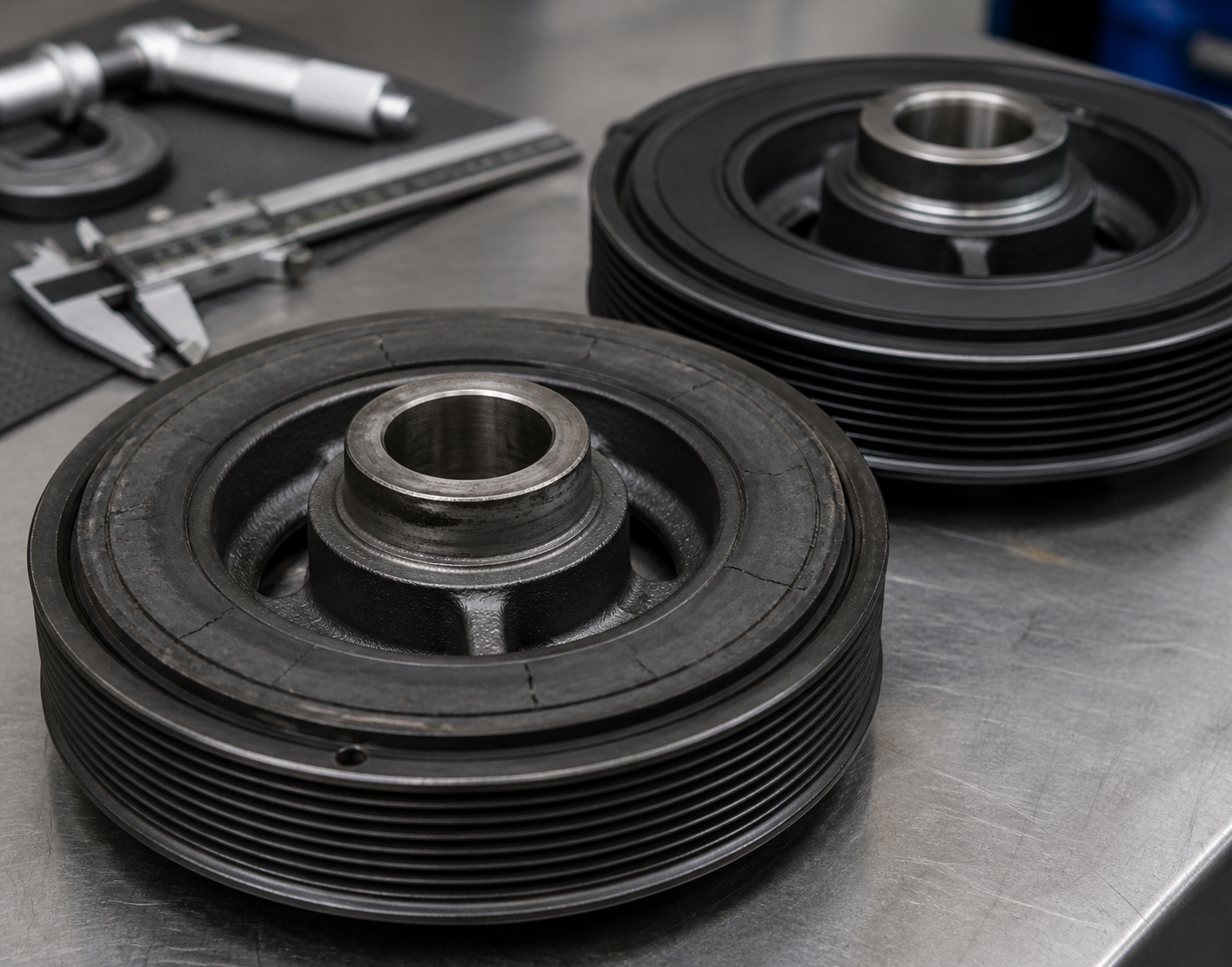
Type overview of the crankshaft pulley
The spare parts catalog lists various designs that differ in degree of attenuation and area of application — a mere replacement with a visually similar part is risky due to different damping properties.
| Type | Advantages / Application Focus | Typical Boundaries |
| Undamped pulley | Cheap and robust construction, lower weight | No vibration damping; leads to increased wear on the power take-off in modern engines |
| Simple vibration damper | Standard solution for many gasoline and diesel engines; Reduces torsional vibrations | Wears out at high mileage; Rubber element can become brittle |
| Double vibration damper | High-quality damping for powerful diesel engines with pronounced low-frequency vibrations | Complex structure; Higher costs due to multi-component design |
| Decoupled pulley | Use of springs or plain bearings to decouple the belt drive | Sensitive to environmental influences such as oil or strong temperature fluctuations |
| Variant for start-stop systems | Designed for frequent load changes and high starting frequencies | Do not replace in engines without start-stop specification without testing |
| Pulley with freewheel function | Decouples the drive from load peaks, protects generator and belt | Complex mechanics; Bearing grease ages over time |
| Compact full-metal design | Simple design for older engine generations or simple designs | Generates stronger vibrations in the power take-off in modern engines |
Advantages and limitations of the crankshaft pulley
Replacement with a high-quality new part ensures the smooth running of the engine drive and prevents consequential damage to expensive auxiliary units such as alternators or air conditioning compressors.
Advantages of the crankshaft pulley
- Effective damping of torsional vibrations protects bearings of auxiliary units
- Reduces noise emissions due to absorbent elastomer elements
- Longer service life of the entire belt drive due to reduced load peaks
- Restoration of the exact belt alignment prevents premature wear of the drive belt
Disadvantages of the crankshaft pulley
- Wear of the rubber element is not always immediately visible
- High load on the central screw requires special assembly tools
- Loss of damping function leads to unsteady engine running and vibrations
- Incorrect design endangers the mechanical strength of the crankshaft
Where is the crankshaft pulley used?
This component is located exclusively at the front end of the crankshaft, directly on the front side of the engine, and serves as the central unit for the entire engine drive.
- Belt drive for auxiliary units: It drives the alternator and the air conditioning compressor via the V-ribbed belt, which is crucial for power supply and comfort.
- Auxiliary steering systems: In vehicles with hydraulic power steering, it drives the power steering pump and thus guarantees the functionality of the steering.
- Cooling system support: The water pump is often also operated via the belt driven by the crankshaft sprocket, which is essential for the overall heat balance of the engine.
- Engine damping: In almost all modern diesel and powerful gasoline engines, it serves as a torsional vibration damper to minimize the loads on the crankshaft due to the combustion principle.
How do I choose the right crankshaft pulley?
| Criterion | What to check | Relevant to |
| Engine Code / Vehicle VIN | Exact query in the catalogue using key numbers | All engine types |
| Damping Type | Comparison with old parts: Damped or rigid? | Engine Running Smoothness |
| Groove profile | Number of grooves and profile shape of the belt | Accuracy of fit |
| Air conditioning equipment | Consider the need for additional belt travel | Accessory connection |
| Diameter | Changing the translation if the size is wrong | Speed of the units |
| Mounting type | Central screw or several fastening screws | Assembly |
| Material | Cast iron or steel to match OEM specification | Shelf life |
The selection must be precise, as the engine code, transmission type and equipment variants (e.g. with or without air conditioning) determine the specifications.
The most important criterion is identification via the engine code. A new part from a brand manufacturer that meets the exact requirements of the vehicle is the safest choice.
Correct application, care and storage of the crankshaft pulley
Professional installation and regular inspection prevent creeping wear from leading to sudden failure.
Technology and common mistakes when installing the crankshaft pulley
A common mistake is the use of an impact wrench for disassembly or assembly, which can lead to structural damage. Equally critical is the reuse of old screws, which are often designed as expansion screws.
The windshield must be mounted without tension. If necessary, markings on the timing belt housing or block for the correct positioning of the crankshaft should be observed during assembly so as not to affect the timing times.
The following applies to all work: use torque wrenches according to the manufacturer’s specifications. The use of special tools to hold the crankshaft against it is essential for many models.
- No use of force by blows, as the damping elements are damaged
- Use of new central screws to ensure the correct torque
- Careful cleaning of the contact surface on the crankshaft from rust or deposits
- Alternator freewheel check every time the pulley is changed
- Ensuring the correct belt travel direction for marked components
- Not using impact wrenches to tighten fasteners
Care and storage of the crankshaft pulley
The service life is strongly influenced by external influences and the condition of the surrounding belt drive.
- Regular visual inspection for cracks in the rubber element from approx. 60,000 km
- Protection against contact with oil and chemical liquids, as they attack the elastomer
- When washing the engine, make sure that no cleaning agents get into the damping gaps
- Storage of new parts in a dry, cool place and protected from direct sunlight
- Avoidance of stacking so as not to jeopardize the dimensional stability of the outer ring
- Belt tension test to avoid overloading the pulley
Useful accessories for the crankshaft pulley
The replacement of the pulley is often associated with the renewal of the entire belt drive.
- V-ribbed belt (always replace together with the pulley)
- Tensioner pulley and pulley for the belt drive
- New fastening screws (mandatory for expansion screw constructions)
- Alternator freewheel (if available)
- Crankshaft oil seal (if accessible during assembly)
- Special tool for counter-holding the crankshaft
- Cleaning utensils for the mating surfaces
- Heat-resistant grease for mounting points (according to manual)
It is advisable to replace all components of the genset drive in a single operation in order to ensure long-term operational safety.
Buy pulley, crankshaft at AuraMaia
By selecting the vehicle, engine code or OEM number, the AuraMaia catalogue can be used to narrow down the right pulley or crankshaft. AuraMaia offers 9857 items from 100 leading manufacturers — see the product description for damping type and scope of delivery.
Before ordering, the engine code and any special features such as the air conditioning equipment must be checked. When comparing with the old part, the number of grooves and the fastening pattern on the central screw should be compared with the technical data sheets of the new parts.