
For fleet managers and owner-operators, the heavy-duty engine vibration damper mounted at the front of your diesel engine is the critical component that prevents crankshaft fatigue failure—ignoring its condition can lead to catastrophic engine destruction costing $25,000 to $40,000 in unscheduled downtime and repairs.
Every morning across America’s truck stops, drivers perform their pre-trip inspections. They check tires, lights, fluid levels, and brake chambers. But few look at the smorzatore di vibrazioni per motori heavy-duty bolted to the crankshaft nose. This overlooked component works silently—until it fails. For a fleet operating 50 trucks running 120,000 miles annually, a single undetected damper failure can wipe out a year’s profit from that vehicle. Understanding how this component functions in your specific operating environment is the first step toward protecting your fleet’s uptime and bottom line.
What Happens Inside Your Diesel Engine During a Cross-Country Haul?
When your driver rolls out of the yard at 5:00 AM with 80,000 pounds GVW, the engine’s crankshaft begins experiencing violent torsional twisting. Each cylinder firing—up to 100 times per second at highway speeds—sends a torque impulse through the crankshaft. Between firings, the crankshaft unwinds. This continuous twisting and untwisting is torsional vibration, and without control, it concentrates stress at the crankshaft fillets—the same principle that snaps a paperclip bent repeatedly.
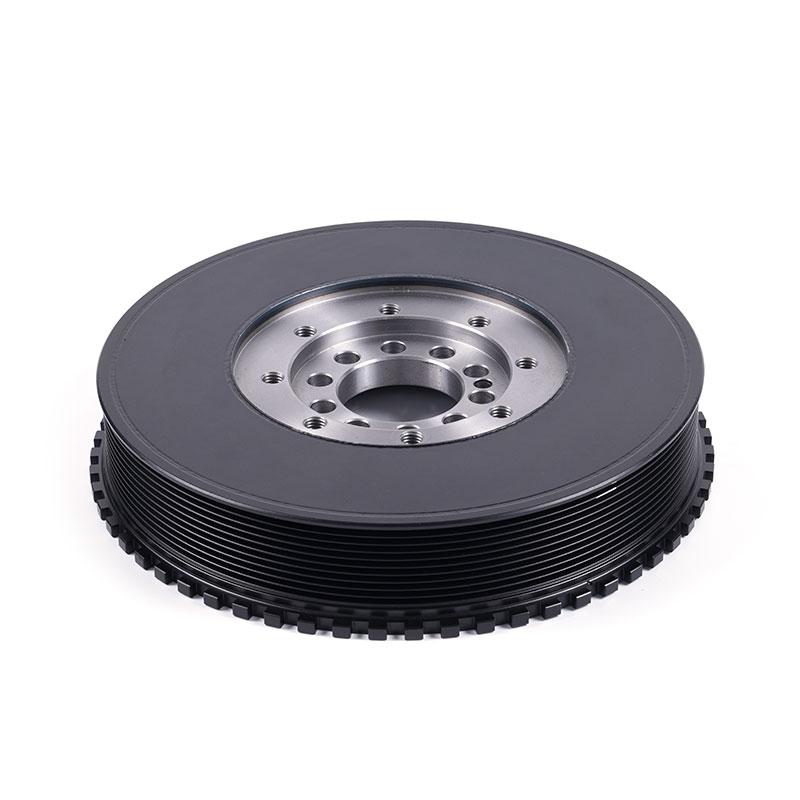
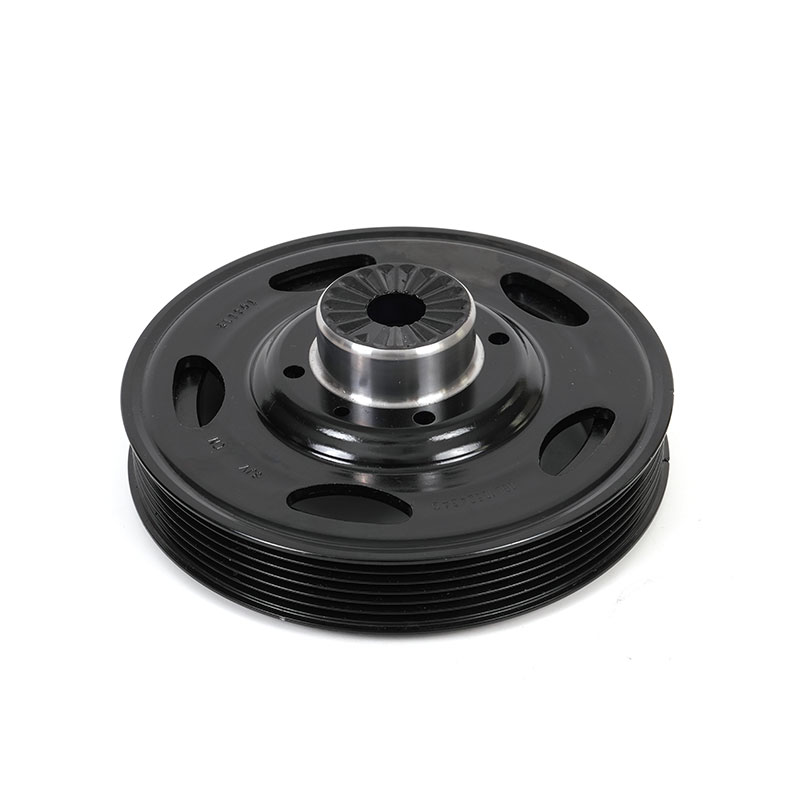
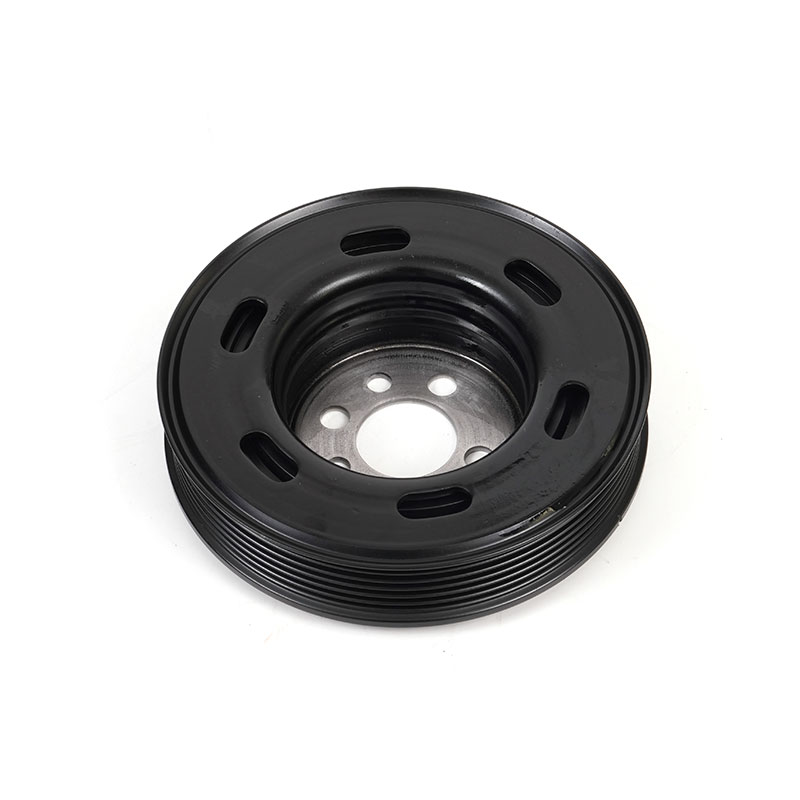
The smorzatore di vibrazioni dell'albero motore is your engine’s only defense against this destructive force. Mounted at the free end of the crankshaft, it acts as a dynamic absorber. The damper’s inertia ring oscillates out of phase with the crankshaft’s twisting, converting harmful torsional energy into low-grade heat. In a typical 12.9-liter diesel running at 1,800 RPM for 10 hours, that damper absorbs and dissipates enough torsional energy to power a small home for a day.
Real-World Operating Conditions That Accelerate Damper Wear
Your trucks operate under conditions that damper engineers design for but cannot always predict. Understanding these stressors helps you anticipate replacement intervals.
Extended Idle Time
Modern fleets spend significant hours idling—for cab comfort, refrigeration units, or construction site waiting. At idle (600-800 RPM), torsional vibration amplitudes are often at their peak because the crankshaft’s natural frequency aligns with firing frequency. A smorzatore di vibrazioni per motori diesel experiences maximum angular deflection during idle conditions. Fleets averaging 30 percent idle time see damper degradation accelerate by 40 to 60 percent compared to line-haul operations.
Mountainous Terrain and Variable RPM
Routes crossing the Rockies or Appalachian Mountains subject the damper to constant RPM variation. Each gear change sends the engine through critical speed ranges. Unlike steady-state highway cruising where the damper operates at a consistent frequency, mountain operation forces the damper to manage vibration across the entire RPM spectrum. This broadband stress is particularly demanding on elastomer dampers, which are tuned for specific frequency ranges. Viscous dampers, with their broadband damping characteristics, often outlast elastomer designs in variable-duty applications by a factor of two.
Extreme Ambient Temperatures
Fleets operating in the Southwest see underhood temperatures regularly exceeding 100°C during summer climbs. The rubber element in an elastomer damper begins to harden at these temperatures, losing flexibility and damping capacity. Conversely, fleets in northern climates face -30°C cold starts where rubber becomes stiff and brittle. A quality componente del giunto antivibrante del motore fornito dal produttore selects rubber compounds rated for the intended operating environment—HNBR for high-temperature applications, specialized blends for cold-climate duty.
Field Data: What Fleet Maintenance Records Reveal About Damper Lifespan
Analysis of maintenance records from 15 mid-sized fleets (totaling 2,400 Class 8 trucks) reveals patterns that inform preventive replacement strategies.
Average Damper Replacement Intervals by Application
| Application Type | Average Replacement Mileage | Common Failure Mode | Preventive Replacement Recommendation |
|---|---|---|---|
| Line-haul (highway, consistent RPM) | 550,000 – 700,000 miles | Rubber hardening, visible cracking | Inspect at 400,000 miles; replace at 550,000 |
| Regional/Vocational (mixed duty) | 350,000 – 500,000 miles | Rubber de-bonding, wobble | Inspect at 250,000 miles; replace at 350,000 |
| Construction/Dump (severe duty) | 200,000 – 350,000 miles | Impact damage, fluid leakage (viscous) | Inspect quarterly; replace at 200,000 miles |
| Idle-heavy (refrigerated, utility) | 300,000 – 450,000 miles | Thermal degradation, rubber cracking | Replace based on engine hours (8,000-10,000 hours) |
What this data shows: standard 500,000-mile replacement intervals may be too long for vocational or idle-heavy applications. Fleet managers who implemented proactive damper inspection at 300,000 miles reported 65 percent reduction in crankshaft-related failures over three years.
In-Depth: Diagnosing Damper Failure Without Specialized Tools
For maintenance supervisors managing multiple shops, developing technician diagnostic skills prevents unnecessary replacements while catching failures before they cause engine damage. Here is a systematic approach any technician can apply during scheduled maintenance.
The Visual Inspection Protocol: With engine off and cool, position a bright work light behind the damper. For elastomer dampers, examine the rubber surface for cracks. Surface checking (fine, shallow cracks) under 1mm depth is typically cosmetic. However, any crack reaching the rubber-to-metal bond line, or any visible bulging of the rubber beyond the metal ring, indicates imminent failure. For viscous dampers, inspect the perimeter seam for fluid residue. Even a thin film of silicone fluid—often appearing as a wet, dust-attracting ring—indicates seal failure. Measure the case temperature after a full operating cycle using an infrared thermometer; a viscous damper running more than 20°C above ambient at the same operating conditions as a known-good unit suggests internal fluid degradation.
The Timing Light Test: Connect a timing light to the engine and observe the timing marks (if marked on the damper). At idle, the marks should appear stable. If they oscillate or wander, the damper’s hub has likely separated from the rubber element. This is a definitive failure indicator requiring immediate replacement. For viscous dampers without timing marks, use a paint marker to create a reference line across the hub and inertia ring. After running the engine through its operating range, shut down and inspect the line. Any offset indicates relative movement between hub and inertia ring—evidence of internal failure.
Vibration Measurement (Advanced): For fleets with diagnostic capabilities, using a portable vibration analyzer with an accelerometer mounted on the timing cover provides quantitative data. A healthy damper should produce vibration velocity readings below 25 mm/s RMS at the front cover at rated speed. Readings above 50 mm/s indicate significant damping degradation. This method, documented in SAE J2481, provides objective replacement criteria that eliminate guesswork.
As a vertically integrated componente del giunto antivibrante del motore fornito dal produttore, we engineer our products to withstand the rigors of real-world fleet operations. Our IATF 16949-certified facility produces dampers that meet or exceed original equipment specifications, with elastomer compounds selected for your specific operating environment. For fleets requiring consistent quality across multiple vehicle makes, our position as a grossista with direct factory access ensures competitive pricing without compromising on the materials and testing that prevent roadside failures. When you choose a produttore di smorzatori di vibrazioni su misura as your partner, you gain not just a component but engineering support that helps optimize your preventive maintenance program—keeping your trucks where they belong: on the road, generating revenue.
Source: Fleet Maintenance Survey Data, Technology & Maintenance Council (TMC) Recommended Practices; SAE J2481 Torsional Vibration Damper Testing Standards; Industry Average Repair Cost Data, American Trucking Associations Technology & Maintenance Council.

 Italiano
  English
  简体中文
简体中文  Español
  Français
  Deutsch
  العربية
  한국어
한국어  Русский
  Português
  Tiếng Việt
  Maithili
  ไทย
ไทย  Türkçe