
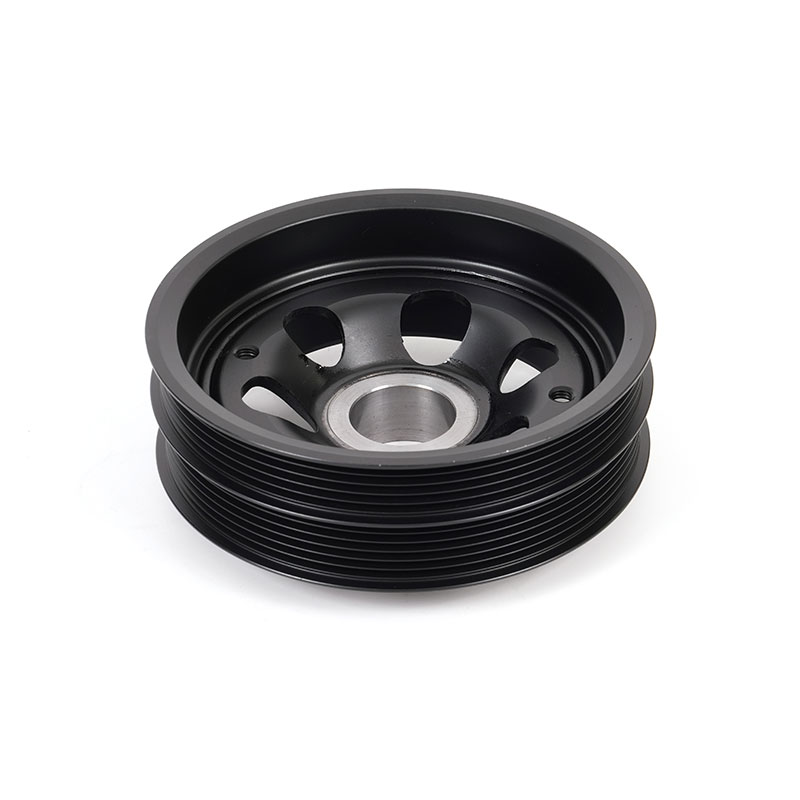
For power generation professionals, a fluid damper (also called a viscous damper hoặc bộ giảm chấn rung động động cơ) is as critical as the alternator or the fuel system. A generator engine runs at constant governed speed (typically 1500 or 1800 RPM) but faces unique stresses: sustained thermal load, sudden load transients, and extended idle periods during standby duty. Unlike a rubber harmonic damper pulley, a fluid viscous damper provides consistent broadband control without frequency‑specific tuning, making it the preferred choice for prime power and critical standby applications.
For prime power generators running 24/7, fluid viscous dampers should be replaced every 25,000 operating hours or during major overhauls. For standby generators with low hours, time‑based replacement at 8‑10 years is recommended, regardless of operating hours, due to seal aging and fluid polymerisation. A failed damper in a generator set can cause crankshaft failure during the moment the power is most needed.
Auramaia is a China‑based Nhà sản xuất và Nhà cung cấp of fluid dampers for generator sets, serving OEMs, rental fleets, and aftermarket distributors. Our Có thể tùy chỉnh OEM/ODM capabilities include severe‑duty thermal management, remote monitoring compatibility, and full documentation for export compliance.
Prime Power vs. Standby: Two Different Demands
Generator applications divide into two categories with distinctly different damper requirements:
- Prime power (continuous operation): These generators run unlimited hours annually with variable loads. The damper faces sustained thermal stress and continuous fluid shear. Vibratech TVD’s general guideline for stationary engines and gensets is 25,000 hours. For prime power, viscous dampers are strongly preferred over rubber due to their superior thermal stability.
- Standby generators (low hours, critical reliability): These units may operate only 50‑200 hours annually during weekly exercise runs, but they must perform instantly during an outage. Here, time‑based degradation (seal aging, fluid polymerisation) drives replacement regardless of hours. Industry practice recommends damper replacement every 8‑10 years for standby generators.
Deep Dive: Load Transients and Thermal Management
A generator experiences rapid load changes when large motors start or when the facility draws sudden power. Each load transient sends a torsional shock through the crankshaft. In a prime power application, these transients occur hundreds of times daily, creating a cumulative fatigue load on the damper. The energy dissipation equation P = μ × (Δω)² × V governs heat generation, where μ is fluid dynamic viscosity, Δω is angular velocity difference between housing and inertia ring, and V is fluid volume in the shear gap. For a typical 500 kW generator operating at 1800 RPM, the damper dissipates approximately 500‑800 watts of heat as power during sustained operation. If this heat cannot be dissipated efficiently, the silicone fluid temperature rises, accelerating polymerisation.
Advanced generator dampers use optimised housing geometry with cooling fins or enhanced surface area to radiate heat. For continuous‑duty applications, Auramaia engineers can specify housings with increased thermal mass and high‑grade silicone fluids with enhanced oxidation resistance. Additionally, remote damper monitoring—using temperature sensors connected to the generator’s SCADA system—allows operators to track thermal performance in real time. A sudden 15‑20°C temperature rise at constant load is a definitive indicator of fluid degradation, enabling predictive maintenance scheduling before catastrophic failure occurs.
Load Types and Their Impact on Damper Life
Not all generator loads are equal. Understanding the load profile helps predict damper wear:
- Motor starting (direct‑on‑line): Tạo ra một xung torque tức thời từ 600‑800% torque định mức, gây ra một cú sốc xoắn lớn duy nhất. Các thiết bị khởi động mềm làm giảm đáng kể ứng lực này.
- Tải khối (toàn bộ tải cơ sở): Đại diện cho điều kiện quá tải duy trì từ 100‑150% torque định mức. Yêu cầu một bộ giảm chấn với biên độ nhiệt đầy đủ.
- Chu trình máy nén: Tạo ra các cú sốc vừa lặp đi lặp lại (200‑300% torque định mức). Bộ giảm chấn nhớt xử lý các chu kỳ này tốt hơn cao su.
- Tải bộ lưu điện/ chỉnh lưu: Tạo ra méo hài liên tục. Bộ giảm chấn nhớt cung cấp khả năng kiểm soát băng thông rộng hiệu quả cho các tải không hình sin này.
Tại Sao Bộ Giảm Chấn Nhớt Vượt Trội Ứng Dụng Máy Phát Điện
Bộ giảm chấn đàn hồi cao su thường không phù hợp cho nguồn điện chính vì nhiệt duy trì khiến cao su cứng lại trong vài nghìn giờ vận hành. Một khi đã cứng lại, bộ giảm chấn mất hiệu quả và thậm chí có thể truyền nhiều rung động hơn đến trục khuỷu. Bộ giảm chấn nhớt, với chất lỏng silicone và cấu trúc kim loại-kim loại, duy trì hiệu suất ổn định trong suốt vòng đời hoạt động. Nhiều OEM máy phát điện hiện nay quy định bộ giảm chấn nhớt là thiết bị tiêu chuẩn cho định mức công suất chính. Auramaia cung cấp bộ giảm chấn nhớt được thiết kế đặc biệt cho nhiệm vụ máy phát điện, với độ bền phớt nâng cao cho thời gian chờ kéo dài và lớp phủ chống ăn mòn cho lắp đặt ngoài trời.
Lắp Đặt và Bảo Trì Bộ Giảm Chấn Máy Phát Điện
- Trong quá trình đại tu máy phát điện, luôn thay thế bộ giảm chấn. Chi phí nhân công đã được tính toán sẵn, và chi phí của một bộ giảm chấn mới là không đáng kể so với hỏng hóc trục khuỷu.
- Kiểm tra bộ giảm chấn trong mỗi lần bảo dưỡng định kỳ hàng năm. Kiểm tra rò rỉ chất lỏng, biến dạng vỏ và nhiệt độ bề mặt quá mức.
- Đối với máy phát điện chính, hãy cân nhắc lấy mẫu chất lỏng. Bộ giảm chấn khung lớn với nắp tháo rời cho phép phân tích silicone để xác định tuổi thọ còn lại.
- Lưu trữ bộ giảm chấn dự phòng trong môi trường được kiểm soát khí hậu. Nhiệt độ cực cao đẩy nhanh lão hóa phớt; nhiệt độ cực lạnh nhìn chung không phải là vấn đề đối với chất lỏng silicone.
Câu Hỏi Thường Gặp: Bộ Giảm Chấn Chất Lỏng Máy Phát Điện
Khoảng thời gian thay thế cho bộ giảm chấn chất lỏng máy phát điện là bao lâu?
For prime power (continuous operation), Vibratech TVD’s guideline is 25,000 hours. For standby generators (low hours, critical reliability), time‑based replacement at 8‑10 years is recommended, regardless of operating hours, due to seal aging and fluid polymerisation.
Can a fluid damper be used on a bi‑fuel generator?
Yes. However, different fuels (natural gas vs. diesel) have different combustion characteristics, affecting torsional excitation. Ensure your supplier validates the damper for your specific fuel type and mixture.
Điều gì xảy ra nếu chất lỏng silicone bị rò rỉ?
Mất chất lỏng dẫn đến khả năng giảm chấn bằng không, gây ra nguy cơ hỏng trục khuỷu ngay lập tức. Động cơ sẽ biểu hiện rung động nghiêm trọng. Dừng máy phát điện ngay lập tức và thay thế bộ giảm chấn.
Do you offer private labelling for generator distributors?
Yes, as an OEM/ODM Nhà sản xuất, we offer private labelling with your brand, custom packaging, and specific torque specifications printed on the unit for installer convenience.
Why are viscous dampers preferred over rubber for generator applications?
Viscous dampers offer superior thermal stability (up to 150°C vs. 100°C for rubber), broadband damping across all frequencies, and no bonded rubber to harden or crack. For continuous‑duty prime power, these advantages translate directly to longer engine life and reduced downtime.
Sources: Vibratech TVD – Heavy Duty Engine Damper Replacement & Remanufacturing Options (2017); Prime, Standby, and Continuous Generator Ratings (industry standards); Auramaia engineering data.

 Tiếng Việt
  English
  简体中文
简体中文  Español
  Français
  Deutsch
  العربية
  한국어
한국어  Русский
  Português
  Italiano
  Maithili
  ไทย
ไทย  Türkçe